Friday, July 09, 2004
On a scale of 1 to 10, how thrilled am I with this?
The NYTimes has an article today (here) about the expansion of high speed internet access. Yes, its availability is expected now in hotels, cafés, airports. But trains? Planes? Automobiles?
The article addresses the difficulties of establishing Internet connections in moving vehicles with metal “skins.” Still, I think the expectation is that soon, the world will be one big hot spot.
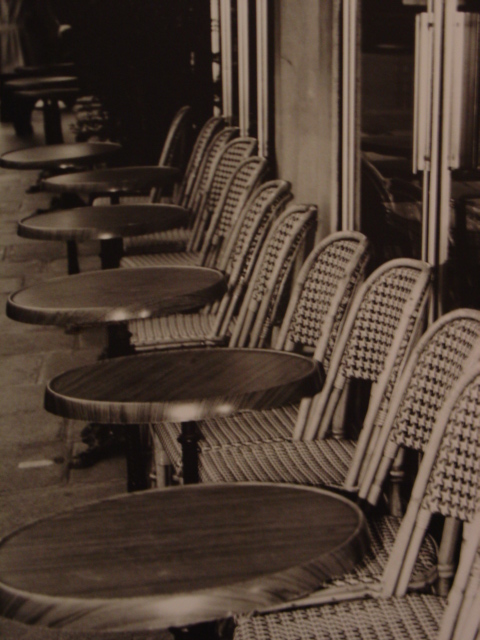
Do I welcome these developments? Hard to say. I am thrilled that I can now work on my computer at Borders bookstore. But why is that so? It’s a bookstore, darn it, why do I feel compelled to take my work or my Internet surfing to a bookstore? Shouldn’t the ethicist speak out about this? Am I in any way contributing to the sales of books? And how about cafés: I like taking my computer there as well. But wait: what if my favorite cafés in France had a row of laptop users pounding away. Here, take this photo (below, taken just last year) and use your imagination. Place Parisians with computers at all the sidewalk tables. It’s WRONG!
Yet, just me sitting there blogging about the joys of people watching in Paris – I can make an exception for that…
I’m inconsistent. I want the options for myself but I want the rest of the world to take heed: laptops on long flights? Maybe. But not in French cafés. Please, let there be a few sacred spots in the world.
The article addresses the difficulties of establishing Internet connections in moving vehicles with metal “skins.” Still, I think the expectation is that soon, the world will be one big hot spot.
Do I welcome these developments? Hard to say. I am thrilled that I can now work on my computer at Borders bookstore. But why is that so? It’s a bookstore, darn it, why do I feel compelled to take my work or my Internet surfing to a bookstore? Shouldn’t the ethicist speak out about this? Am I in any way contributing to the sales of books? And how about cafés: I like taking my computer there as well. But wait: what if my favorite cafés in France had a row of laptop users pounding away. Here, take this photo (below, taken just last year) and use your imagination. Place Parisians with computers at all the sidewalk tables. It’s WRONG!
Yet, just me sitting there blogging about the joys of people watching in Paris – I can make an exception for that…
I’m inconsistent. I want the options for myself but I want the rest of the world to take heed: laptops on long flights? Maybe. But not in French cafés. Please, let there be a few sacred spots in the world.
A seasonal adjustment
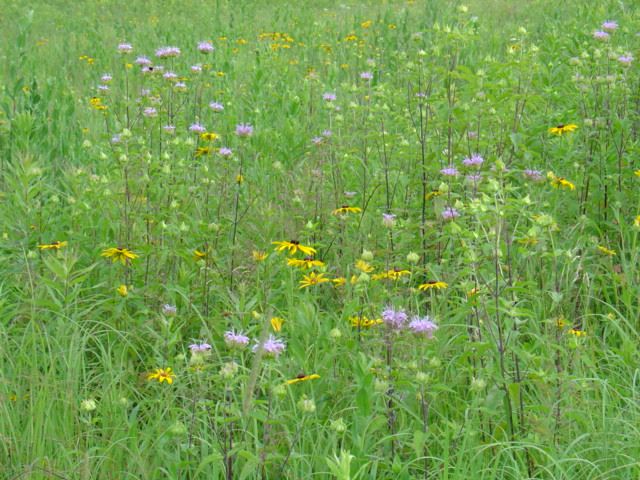
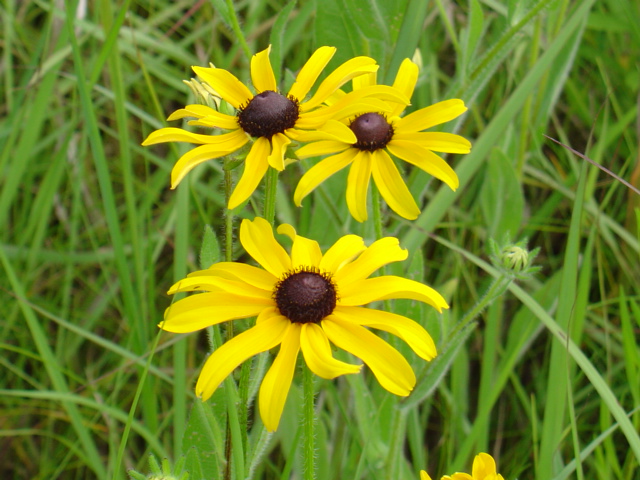
Sometimes when I post something here, I cannot wait to post again, just so that the previous post does not stand out with its atrociously glaring title. Now is such a moment. Christmas on the blog is significantly out of place when I am chasing mosquitoes as I walk. So, just to appease my inner sense of balance let me post three pictures from this morning. They were taken in a place that is a five-minute walk from my house (Owen Woods). Whenever I groan too loudly about life in the suburbs, I am reminded that I have Owen Woods while New Yorkers have trees growing out of concrete slabs every thirty blocks and then I become quiet. [Until my next unhappy suburban moment.]
The prairie restoration project at Owen Woods is wonderful enough, though I think I want to set limits on what in the prairie I want restored. For example, the Black-eyed Susan and Echinacea are just fine, but the bugs – oh the bugs! They are obnoxiously intrusive and if I remember correctly from reading Laura Ingalls Wilder books, they caused one of the girls in the “Little House on the PRAIRIE” to go blind. So, yes to prairie restoration, but can we please do it with an eye toward plants that are repugnant to insect life? [Is that even possible?]
Christmas, communism and the return of the kid with the classy shoes
BoringAng is blogging about Christmas imagery and JeremyF is linking to Christian websites that warn against associating with atheists (might that include Communists? Do these websites see them as overlapping sets? Probably). Putting the two posts together reminds me of the FAQ that came my way (though not recently, and not in July): how did we deal with Christmas in Communist Poland? Given the prevalence of Catholicism even (or especially)in postwar Poland, was it celebrated? Repressed? Berated? Condemned?
Though as I have said before, my non-Catholicism kept me out of the churches during the holidays, I certainly did not mind otherwise horning in on Christmas celebrations. And Poland did (still does) Christmas in a big way, centering it mostly on feasting, but with music, tree-trimming and St. Nicholas thrown in as well (though St. Nick does a disappearing act after St. Nicholas Day early in the month, so as not to detract from the birth of Christ theme around the 24th and 25th). The churches appeared to me crowded year-round and so repression of religion has to be viewed as being somewhat at the level of abstraction. And governance, of course. Government offices had no religious iconography or ornamentation and I never saw a Christmas tree anywhere near the Communist Party headquarters. [Contemporary Poland seems to now scorn the “quaint” idea of separation of church and state.]
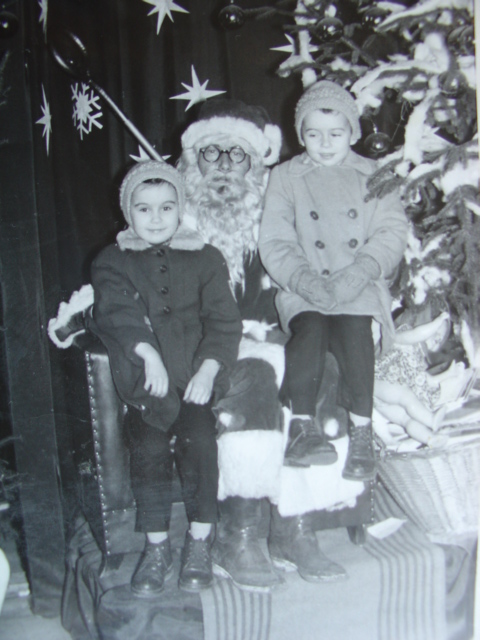
I do have to say, though, that I was a jaded kid. Did I “believe” in St. Nick and his sack of presents? My mother tells me I stopped when I was 5, immediately following the visit to the Warsaw Department store where my sister and I had this picture (below) taken. You can see the “yeah, sure” look on my face (I’m on the right). I am told I went up to “St. Nick” afterwards and told him loudly “you are SO not real,” much to the dismay of the children in line. I am quite ashamed of this now – what a spoiler. Note, as well, the postwar Poland haute couture. I don’t think I realized that people wore shoes for reasons other than protecting the feet from mud and sharp objects until I traveled to the States at the age of 7.

Warsaw, Poland, December 1958
Though as I have said before, my non-Catholicism kept me out of the churches during the holidays, I certainly did not mind otherwise horning in on Christmas celebrations. And Poland did (still does) Christmas in a big way, centering it mostly on feasting, but with music, tree-trimming and St. Nicholas thrown in as well (though St. Nick does a disappearing act after St. Nicholas Day early in the month, so as not to detract from the birth of Christ theme around the 24th and 25th). The churches appeared to me crowded year-round and so repression of religion has to be viewed as being somewhat at the level of abstraction. And governance, of course. Government offices had no religious iconography or ornamentation and I never saw a Christmas tree anywhere near the Communist Party headquarters. [Contemporary Poland seems to now scorn the “quaint” idea of separation of church and state.]
I do have to say, though, that I was a jaded kid. Did I “believe” in St. Nick and his sack of presents? My mother tells me I stopped when I was 5, immediately following the visit to the Warsaw Department store where my sister and I had this picture (below) taken. You can see the “yeah, sure” look on my face (I’m on the right). I am told I went up to “St. Nick” afterwards and told him loudly “you are SO not real,” much to the dismay of the children in line. I am quite ashamed of this now – what a spoiler. Note, as well, the postwar Poland haute couture. I don’t think I realized that people wore shoes for reasons other than protecting the feet from mud and sharp objects until I traveled to the States at the age of 7.

Warsaw, Poland, December 1958
Thursday, July 08, 2004
A musing
Occasionally, in a moment of musing about your past, you google a memory. Indeed, this is what must have happened, as I got the most remarkable email today from someone who reached this blog by googling the lyrics to the “United Nations” song that I used to love so much back in my elementary school days at the UN International School.
The reader writes: I googled "United Nations on the march" and found the lyric at your site. As a youngster at a bungalow colony day camp in the Catskils in the 1940s we sang the song. Sadly, I haven't heard it since.
This, then, is the power of the blog. It allows you to get close to people over “blogger dinners.” It allows for friendship to grow exponentially. And, it allows you to talk to someone who, 20 years before your own elementary school days, was belting “Take heart all you nations swept under!” at a camp in the Catskills.
Happy bloggerversary to JFW, the blog that gave me a leg up on this blogging business.
The reader writes: I googled "United Nations on the march" and found the lyric at your site. As a youngster at a bungalow colony day camp in the Catskils in the 1940s we sang the song. Sadly, I haven't heard it since.
This, then, is the power of the blog. It allows you to get close to people over “blogger dinners.” It allows for friendship to grow exponentially. And, it allows you to talk to someone who, 20 years before your own elementary school days, was belting “Take heart all you nations swept under!” at a camp in the Catskills.
Happy bloggerversary to JFW, the blog that gave me a leg up on this blogging business.
This has happened to me!
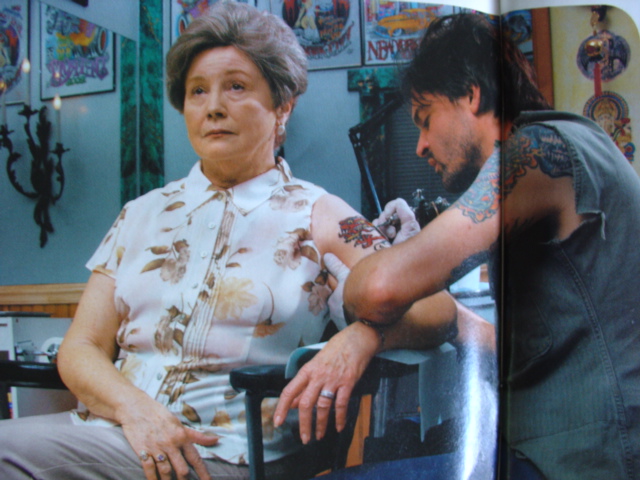
I opened the New Yorker this afternoon to the following ad from a credit card company:

(nc: poor Glenna -- she takes the plunge and then gets mocked for it by a credit company!)
Alongside the photo were these words: It didn’t seem right to us, either. We thought it a little odd that Glenna from Duluth would spend $282 at the Screaming Needle in Hollywood. With Fraud Early Warning, XX can recognize unusual spending and stop it.
Now wait a minute! There is a clear insinuation that a 50 + (okay maybe a bunch of pluses) woman living in Duluth is staid and priggish and that she lacks an irreverent side that would cause her to hop on a plane to LA and get herself a tattoo.
Maybe. I don’t know Glenna. But then, does XX Company? And what else do they know about Glenna? Is there a person who goes through her every receipt and says “Yep, that fits, that’s Glenna!” or “No way would she buy something so gauche, so risqué, that Glenna, she’s no spring chicken now is she? And from Duluth, too.”
I’ve had my card rejected in places and so I know the feeling. I have been warned by operators whom I have frantically called to avoid the embarrassment of being arrested for non-payment, that next time I would be well advised to call ahead, to warn the company of impending odd expenses in weird and out-of-the-way places. It’s for my own protection, after all. What, from myself??

(nc: poor Glenna -- she takes the plunge and then gets mocked for it by a credit company!)
Alongside the photo were these words: It didn’t seem right to us, either. We thought it a little odd that Glenna from Duluth would spend $282 at the Screaming Needle in Hollywood. With Fraud Early Warning, XX can recognize unusual spending and stop it.
Now wait a minute! There is a clear insinuation that a 50 + (okay maybe a bunch of pluses) woman living in Duluth is staid and priggish and that she lacks an irreverent side that would cause her to hop on a plane to LA and get herself a tattoo.
Maybe. I don’t know Glenna. But then, does XX Company? And what else do they know about Glenna? Is there a person who goes through her every receipt and says “Yep, that fits, that’s Glenna!” or “No way would she buy something so gauche, so risqué, that Glenna, she’s no spring chicken now is she? And from Duluth, too.”
I’ve had my card rejected in places and so I know the feeling. I have been warned by operators whom I have frantically called to avoid the embarrassment of being arrested for non-payment, that next time I would be well advised to call ahead, to warn the company of impending odd expenses in weird and out-of-the-way places. It’s for my own protection, after all. What, from myself??
Cost – Benefit Analysis
Last night I attended a blogger dinner: five bloggers (representing Boring, Bed, SirEP and Ocean) sat face to face and talked about the trials and tribulations of life in the big league (of work? academia? blogging? all of the above). Why call it a blogger dinner? Why not just dinner with friends? Because this, like my dinners with Mother In Law and with A, B & F, would not have happened were it not for our blogging. Indeed, in this case, I would never have met the people at all. There is unquestionably a sizable social benefit to this blogging thing.
However, there is also a cost. I have noticed that one side effect of blogger dinners is that people feel terribly anxious about posting something about the event afterwards. It’s as if we have to be especially witty and clever and insightful, we have to stretch ourselves beyond our normal boring selves. In other words, we have to put out a spin that exceeds our capacities.
Well NOT ME! I will not let this become a permanent liability, a cost, a burden, I will lead by example, set the pace, storm ahead with a DUMB POST ABOUT THE BLOGGER DINNER!
Keep that in mind as you read my not especially profound observations about last night:
1. It was one of those interesting situations where you’re sitting there waiting and only one other person shows up. Many minutes pass and still it’s just the two of you. You wonder, have I posted something recently that offends? Did they all get pulled over by a police car and are now talking themselves out of a jail sentence for speeding? What? [ans: the latter.]
2. This was a sober bunch. It’s been a while since I’ve been out with a group of people where the dominant and most popular drink was water. I did not cave in to peer pressure. I stayed with my rule that if it’s a dinner where the entrees cost more than $5.99 per plate then there should be wine.
3. Talk fast or be prepared to move when the waiters start putting up chairs on tables, hinting that you’re overstaying your welcome. It’s Madison: the chairs on tables routine begins at 10. What would this town do without the Barnes & Noble café, which stays open until 11…
4. My devious subtle testing revealed that the bloggers have been reading Ocean. They knew, for instance, that I had misspelled “hardy peasant stock.” [it appears as “hearty” in the blog – something that I affectionately preserve only in part because I don’t retro-edit posts that are more than a day old.] Or, they were good at faking it.
5. The bloggers I met are terrific. They are witty and smart and funny and cool. The lesson: if your blog is good, you’re no dork.
6. A photo. There must be a photo. The Ocean rep took it and so she is missing from the pack. The rest-- here they are, the whole boring, beddy, sirepy bunch of them:
However, there is also a cost. I have noticed that one side effect of blogger dinners is that people feel terribly anxious about posting something about the event afterwards. It’s as if we have to be especially witty and clever and insightful, we have to stretch ourselves beyond our normal boring selves. In other words, we have to put out a spin that exceeds our capacities.
Well NOT ME! I will not let this become a permanent liability, a cost, a burden, I will lead by example, set the pace, storm ahead with a DUMB POST ABOUT THE BLOGGER DINNER!
Keep that in mind as you read my not especially profound observations about last night:
1. It was one of those interesting situations where you’re sitting there waiting and only one other person shows up. Many minutes pass and still it’s just the two of you. You wonder, have I posted something recently that offends? Did they all get pulled over by a police car and are now talking themselves out of a jail sentence for speeding? What? [ans: the latter.]
2. This was a sober bunch. It’s been a while since I’ve been out with a group of people where the dominant and most popular drink was water. I did not cave in to peer pressure. I stayed with my rule that if it’s a dinner where the entrees cost more than $5.99 per plate then there should be wine.
3. Talk fast or be prepared to move when the waiters start putting up chairs on tables, hinting that you’re overstaying your welcome. It’s Madison: the chairs on tables routine begins at 10. What would this town do without the Barnes & Noble café, which stays open until 11…
4. My devious subtle testing revealed that the bloggers have been reading Ocean. They knew, for instance, that I had misspelled “hardy peasant stock.” [it appears as “hearty” in the blog – something that I affectionately preserve only in part because I don’t retro-edit posts that are more than a day old.] Or, they were good at faking it.
5. The bloggers I met are terrific. They are witty and smart and funny and cool. The lesson: if your blog is good, you’re no dork.
6. A photo. There must be a photo. The Ocean rep took it and so she is missing from the pack. The rest-- here they are, the whole boring, beddy, sirepy bunch of them:
Wednesday, July 07, 2004
too much text, too little color
In late winter, I would post spring updates here, pulling photos off the web to illustrate where my garden was heading. Then I stopped. There was so much color elsewhere that I did not need to sprinkle the blog with garden photos. But today I noted paragraph after paragraph of blog text and decided it was time to jazz it up some with flowers from my garden. They thrived this year on neglect. I hardly tended them. Reliably, they came back to show off their true spunky grit and spirit.
Why I stopped going to yoga
Some of the reasons:
1. working out in 98 degree heat was so…toasty.
2. my “all you can yoga in a week for $14” deal ran out.
3. because I have a suspicious nature and I look dubiously at meditative exercises that you can do with your dog. No, not a mistype. Dog. In a BBC article that I picked up off of someone’s blog (sorry, I can’t come up with the link to the blog, but here’s the link to the article) I read that people are now bringing their dogs to yoga classes. The dogs seem to love the various yoga positions and do them effortlessly, almost, in fact, as well as their owners.
Ridiculous? Yes! Especially the part where they all breathe together and hold paws. Read this:
The dogs did most of the things that the humans did. "At the end we were even encouraged to get them to hold their paws together so that we could recite a specially adapted concluding prayer.”[-- this from one of the owners.]
I am willing to see well-behaved French dogs in restaurants with their owners, but somehow extending the imagination to canine yoga is too much of a stretch. Really.
1. working out in 98 degree heat was so…toasty.
2. my “all you can yoga in a week for $14” deal ran out.
3. because I have a suspicious nature and I look dubiously at meditative exercises that you can do with your dog. No, not a mistype. Dog. In a BBC article that I picked up off of someone’s blog (sorry, I can’t come up with the link to the blog, but here’s the link to the article) I read that people are now bringing their dogs to yoga classes. The dogs seem to love the various yoga positions and do them effortlessly, almost, in fact, as well as their owners.
Ridiculous? Yes! Especially the part where they all breathe together and hold paws. Read this:
The dogs did most of the things that the humans did. "At the end we were even encouraged to get them to hold their paws together so that we could recite a specially adapted concluding prayer.”[-- this from one of the owners.]
I am willing to see well-behaved French dogs in restaurants with their owners, but somehow extending the imagination to canine yoga is too much of a stretch. Really.
A long post that spans such topics as Croatian Rockefellers, the Medicis of Florence, Nobel laureates and Polish restaurateurs
Over the years, scientists, entrepreneurs, artists have left their home countries to travel to places where labs are well funded and opportunities to prosper are numerous (mostly in the U.S.). With respect to men and women of science, today’s IHT describes the phenomenon (here) thus:
The world's scientists are like a flock of flamingos that migrates from briny lakes when they dry up and returns only when the lagoons are replenished.
Not surprisingly, many of the home countries, including Poland, are now trying to woo the successful scientists back to their homeland. In Italy and Croatia large-scale research centers are being established to entice those who have left. And the successful expatriates who have made their wealth abroad are being asked to donate large sums of money to keep the centers competitive with their counterparts abroad.
I find the idea of returning in some way to your base, aligning yourself again with your home country, infinitely fascinating. Radman, a Croatian scientists who heads a 25-person lab in Paris, has taken it upon himself to secure donations from fellow expats for the Mediterranean Institute for Life Sciences on the Adriatic Coast. In the article, I read:
“I'm trying to tempt them to play the role of Croatian Rockefellers or the Medicis of Florence," he said. The sales pitch isn't flowery: "What will you get in return? Nothing. Just the glory."
I think there are two types of success stories out there – the Martha Stewart types who do much to camouflage their heritage, even changing their names to Americanize their image (I suppose the title “Martha Kostyra Living” lacks a certain pizzazz; and in all fairness, she was not born in Poland and so her associations are a generation removed from her roots), and then there is the very large second group whose members cannot or will not break with their past. In it we have the musicians – the Chopins and Paderewskis who left and died abroad, but went back again and again in their work to their homeland (Poland); or, we have the “fathers” and “mothers” of disciplines who returned to Poland in significant ways in their scholarship: there is Florian Znaniecki, author of the “Polish Peasant,” a work that I think, can fairly be described as creating the foundations for empirical sociology; Oscar Lange, who, after a successful career in economics at Chicago, went back to Poland and lay the groundwork for the emergent field of Econometrics; or Marie Sklodowska Curie, who named a newly-discovered element after her homeland (“polonium”).
The last I counted, there were some two dozen Nobel Laureates who are either Polish or of Polish origin. Of course, everyone knows about Walesa, Milosz, Szymborska, or even Singer (all Nobel laureates), but does anyone know that the following are also Poles by birth? – Begin (Peace, ’78), Peres (Peace, ’94), Rotblat (Peace, ’95), Agnon (Literature, ’66 – maybe the fact that Poland was partitioned during his childhood caused him to not think in terms of having a homeland), Grass (Literature, ’99 – he, too, said nothing about Poland in his Nobel prize acceptance speech; even in speaking of his childhood and early influences he managed to skip any references to things Polish) and a host of scientists that are not household names here or in Poland. None of these are significantly focused on their country of birth.
On a less grand scale (and belonging to the group of returnees), I met this winter a Polish-French woman who married a French chef and convinced him to open (along with her) a restaurant in Krakow (even though he speaks hardly a word of Polish). She relocated her family to Poland (she had left the country when she was a child), excited at the idea of riding a wave of success there. She told me she wants to be part of the newest “Polish renaissance.”
It’s all intriguing to me – the story of the returning Pole, in spirit or otherwise, the one who can’t quite let go of the past.
The world's scientists are like a flock of flamingos that migrates from briny lakes when they dry up and returns only when the lagoons are replenished.
Not surprisingly, many of the home countries, including Poland, are now trying to woo the successful scientists back to their homeland. In Italy and Croatia large-scale research centers are being established to entice those who have left. And the successful expatriates who have made their wealth abroad are being asked to donate large sums of money to keep the centers competitive with their counterparts abroad.
I find the idea of returning in some way to your base, aligning yourself again with your home country, infinitely fascinating. Radman, a Croatian scientists who heads a 25-person lab in Paris, has taken it upon himself to secure donations from fellow expats for the Mediterranean Institute for Life Sciences on the Adriatic Coast. In the article, I read:
“I'm trying to tempt them to play the role of Croatian Rockefellers or the Medicis of Florence," he said. The sales pitch isn't flowery: "What will you get in return? Nothing. Just the glory."
I think there are two types of success stories out there – the Martha Stewart types who do much to camouflage their heritage, even changing their names to Americanize their image (I suppose the title “Martha Kostyra Living” lacks a certain pizzazz; and in all fairness, she was not born in Poland and so her associations are a generation removed from her roots), and then there is the very large second group whose members cannot or will not break with their past. In it we have the musicians – the Chopins and Paderewskis who left and died abroad, but went back again and again in their work to their homeland (Poland); or, we have the “fathers” and “mothers” of disciplines who returned to Poland in significant ways in their scholarship: there is Florian Znaniecki, author of the “Polish Peasant,” a work that I think, can fairly be described as creating the foundations for empirical sociology; Oscar Lange, who, after a successful career in economics at Chicago, went back to Poland and lay the groundwork for the emergent field of Econometrics; or Marie Sklodowska Curie, who named a newly-discovered element after her homeland (“polonium”).
The last I counted, there were some two dozen Nobel Laureates who are either Polish or of Polish origin. Of course, everyone knows about Walesa, Milosz, Szymborska, or even Singer (all Nobel laureates), but does anyone know that the following are also Poles by birth? – Begin (Peace, ’78), Peres (Peace, ’94), Rotblat (Peace, ’95), Agnon (Literature, ’66 – maybe the fact that Poland was partitioned during his childhood caused him to not think in terms of having a homeland), Grass (Literature, ’99 – he, too, said nothing about Poland in his Nobel prize acceptance speech; even in speaking of his childhood and early influences he managed to skip any references to things Polish) and a host of scientists that are not household names here or in Poland. None of these are significantly focused on their country of birth.
On a less grand scale (and belonging to the group of returnees), I met this winter a Polish-French woman who married a French chef and convinced him to open (along with her) a restaurant in Krakow (even though he speaks hardly a word of Polish). She relocated her family to Poland (she had left the country when she was a child), excited at the idea of riding a wave of success there. She told me she wants to be part of the newest “Polish renaissance.”
It’s all intriguing to me – the story of the returning Pole, in spirit or otherwise, the one who can’t quite let go of the past.
Update on the V.I.P.P.
The missing very important piece of paper (VIPP, see post about it yesterday) is still missing. One moment it was on the counter, the next moment it’s gone.
A reader writes:
Nina,
you have to stop looking for the VIPP. it's time to give up.
a concerned friend,
Tonya B
p.s. did you look in the car?
My response:
I know I have to stop this! But what if it was important? It looked SO important! I checked all cars. The last (and not altogether impossible) theory is that the dog ate it.
p.s. Just in case, I’m not letting go of the garbage today (it’s garbage pick up day on my block). I’m going to dump it all on the driveway as soon as the weather improves and go through it that way. Next, I'll recruit others to help search. They may see something I missed. I may do a dinner party around this theme…It’s here SOMEWHERE, just give me a little more time before I settle for the dog theory.
NOON UPDATE:
p.p.s. thanks, too, sir ep for your words of concern.
A reader writes:
Nina,
you have to stop looking for the VIPP. it's time to give up.
a concerned friend,
Tonya B
p.s. did you look in the car?
My response:
I know I have to stop this! But what if it was important? It looked SO important! I checked all cars. The last (and not altogether impossible) theory is that the dog ate it.
p.s. Just in case, I’m not letting go of the garbage today (it’s garbage pick up day on my block). I’m going to dump it all on the driveway as soon as the weather improves and go through it that way. Next, I'll recruit others to help search. They may see something I missed. I may do a dinner party around this theme…It’s here SOMEWHERE, just give me a little more time before I settle for the dog theory.
NOON UPDATE:
p.p.s. thanks, too, sir ep for your words of concern.
Subscribe to:
Posts (Atom)