Tuesday, June 15, 2004

To be honest...

I came across the following comment the other day: Blogs are places where you can make yourself look better than you really are.

Now is that fair? I could equally posit the opposite: in an encapsulated story from your day, little irksome events and traits may receive greater prominence than they deserve. You may be significantly better, nicer, less odd than in your blog.

Still, in the spirit of balance and fairness, I do feel compelled to admit to some rocky moments from my past. Let me do it through the eyes and words of others.

A good place to poke around in is in my ancient report cards. Did I imply that I rushed through school tripping over my own excellence? Consider this report card from 3rd grade (at the UN school, barely a year after arriving in New York as a shy little thing from Poland):

first semester:


Third grade, second semester -- any improvement?


Silly? Rambunctious? Alright, let's skip ahead a few years. Sixth grade, first semester:


One more try. Sixth grade, second semester:


I did want to balance the red circles with something not quite so...undisciplined and so I inserted a few purple circles to indicate that I did have a small cheering squad out there that gave pats on the back for my exuberant and energetic approach to school (and life in general). Still, you'd think with my initially imperfect English and my unpopular at the time Polishness, I'd be meeker, more to the sidelines, keeping QUIET, at least in the presence of teachers. I seem not to have known how.

Take charge! Load on the good stuff

In an attempt to turn the tide and create for myself on a more positive, cheerful stretch of days [after my morning epiphany that I was slated to tumble into an abyss of gloom if I kept on writing depressing posts on the EU and Poland (see below) each day], I decided to update my “to do” list by inserting some cheerful, buoyant and inspiring activities and eliminating some disagreeable ones.

Here’s what got added:
1. inspiring: yoga with friend who is convinced that this is absolutely the most incredible thing you can do to your body (tomorrow)
2. innovative: dinner with person tonight whom I have never met before, except through blogging
3. consumeristic: a new book, of course, to add to my stack of unread ones
4. indulgent: writing some nice, long emails again, much to the chagrin and consternation of those on the receiving end (I am cheering MYSELF up, not them)
5. so simple I can’t believe I hadn’t thought of it before: baking something extremely difficult that no one will eat because everyone I know is on some kind of diet, and no diet that I know of permits baked goods
6. requiring physical exertion: painting a room comes to mind, or chopping down some trees in the back yard.


Here’s what got deleted:
1. scheduling dental checks – (last week I told the dentist he was my least favorite person in town; he failed to see the humor in this)
2. a reading of the morning headlines (replaced by reading more blogs, especially upbeat ones of which there are many)
3. going to my office tomorrow or the next day or the next day and facing clutter (of unread papers, catalogues, journals, etc.)
4. thinking about having to teach a workshop in several weeks on a topic that’s pretty much a mystery to me
5. writing thank you notes: I have a pile to do, but the list is so old that I am sure those in need of the thanks have resigned themselves to my rudeness by now (I may reinstate this one later on; even as I write this, I am engulfed in a sea of guilt)
6. Doing chores. Period. No more chores. I am staging a boycott of chores. A long boycott. I have HAD it with chores. I quit.

Hope Does NOT Spring Eternal: Facing a Disappointing Election to the New European Parliament

In the Alternative: Quit Reading Newspapers and do Yoga

An informed and astute reader from Poland writes: "The politics of this country are really something... Yesterday were the elections to the European parliament. So far some of the most backward, right-wing, religious (e.g. Liga Polskich Rodzin [nc: the League of Polish Families, which, n.b., opposes Poland’s participation in the EU] - the name says it all) groups are in the lead, with record-low attendance. Why, oh why does Poland have to be the laughing stock with its religious crusades that are so outdated and comical at times?"

Why indeed. I don’t understand why religion and governance create a conservative unity in the way that they do for Poland. Though perhaps it’s to be expected. Poland has always been isolated, torn apart, divided, left to its own. That kind of history invites allegiance to a strong institution that can pull its people together, doesn’t it? Neither the government nor its neighbors have provided certainty or stability. The church authorities have been astute enough to seize every opportunity to fill a void created by the unfortunate alliances that have stood in the way of peace and prosperity for Poland. How ironic that in the end, the church can offer neither peace nor prosperity. Its conservative base will not permit anything but a restatement of tired, archaic principles. How many more decades must pass before Poles realize that they have been had by the church as well?

In the meantime, the European Parliament continues to disappoint those who saw the governing potential of this unique institution. Politicized, filled with under-qualified members and without the popular support of member states (most don’t understand what it is that this institution can accomplish and quite a number are rethinking about the wisdom of EU membership), it is more likely to move slowly, erratically, inconsistently through the maize of reforms that will come before it in the next several years and even the first hurdle – the adoption of the Constitution – again appears insurmountable.

I know, these kinds of reflections are not a healthy way to start a morning. Even the title of the post should be wiped out and given a somewhat more cheery spin. [Note addition of subtitle just now.] There is a reason why I left politics out of the blog for all those weeks. If only I'd stop reading the headlines and commentary coming out of Europe... Skip the morning press, do yoga, look at green trees. Maybe tomorrow.

Monday, June 14, 2004

To tell or not to tell: musings at knife-point

This morning I was at the UW hospital for a needed medical procedure. Obviously it’s not anything debilitating as I am home now blogging energetically.

But I once again confronted the following issue: should I tell the surgeon that, oh by the way, not only am I a lawyer, but I teach torts, which in common parlance is really the same as personal injury law and yes, we devote a good amount of time to medical malpractice?

The benefit of such a revelation: I am sending the message that if there is an iota of greater care that can be expanded, go ahead an expand it now, because I am one of those people who is very comfortable with the courtroom. But that seems rather selfish, doesn’t it? I do have strong communitarian principles engrained in me and these let me know that my medical care should be the same, not better not worse than that of the bloke next in line. Oh come on now, that’s great reasoning in the abstract, but as the surgical team is sharpening the blades, such good collectivist ideology quickly hides under the warm and cozy blanket.

The down side of disclosure: once I tell them I am a lawyer, I can never ever pinpoint them on anything. Questions such as “am I going to die tomorrow?” or "why are you sweating so much and taking four times as long as you had implied for this?" will no longer be answered. It’s too risky. What if they err in their judgment and I turn lawyer-nasty and cause them professional hardship? So they clam up.

Still, the blades are turning my way and in a moment of weakness I tell all.

Unanticipated consequence: this personal revelation cracks a barrier and the team turns chatty. So, the doc working the blades explains how he himself wanted to be a historian but he hated history grad school here at UW and oh, I also teach family law, do I? Why, his wife died young and he became a single father and so he knows what that’s all about and one son is now in Iraq serving in the Army and yes he WANTED to go there and incidentally have I heard of this lawyer he knows since yes, she does practice personal injury law, ha ha ha, some of his best friends are indeed personal injury lawyers… and so on. Whatever benefit I accrued from the “greater care given to the person who might sue,” I lost because he was now entirely focused on his own recollections.

And the technician was no better. Directing a machine, a teeny wrong movement of which could lead me to have permanently damaged vital organs, she informs me that her son is applying to Law School and could I speculate (how, please tell me? You are in my neck area, I dare not move for fear of being slashed in the wrong places) what his chances might be? He got this on his LSATs and that for his GPA, and he comes from a line of UW grads and then there's his sister…

I have always been told that there is something about me that makes people talk and tell their life’s story. I had, up until today, fancied that to be a talent of sorts. I believed that it was my gently persuasive and caring manner that instills trust and confidence. Now I know better. Today I did not cajole gently. I did not encourage this flood of story-telling at all. What they were obviously reacting to was this feature that I have: it is a Concerned Frown that I have had for years and years, which stays on my face no matter what, even if I am laughing with abandon: the Concerned Frown is always in place. Since the team was up there working in its vicinity, it is clearly what inspired the revelations. If you don’t buy it, please consider this:


Wouldn’t you spill your life’s story to a person who looked at you in this way? (I should note that The Concerned Frown was especially pronounced this morning because I was also quite concerned that they would all stray a bit and hit the wrong connective tissue and I would thereafter no longer be connected.)

A P.S. on our very fleeting interest in faraway places

In commenting on my Walesa post (Saturday, below), a very open minded reader writes the following: “I'm always very interested to hear perspectives on the fall of Communism from people who were on the receiving end.” She may be in the minority on this.

I have to say that mine was a strange personal history, since I criss-crossed the ocean too often to fully feel the impact of life under any system – capitalist, communist, or post-communist. My greatest emotional connection (to a country or a system) came during my adolescent years and all those were, indeed, spent in Warsaw (under communist governance). But I thought my 6 years of childhood in New York (during the 60s) were also significantly impressionable, especially as I experienced the American reaction to me (and to my family) at the time.

We were an anomaly in those years. Tourism between Poland and the US came to an almost complete halt after the war, since the US would not grant visas to Poles who hadn’t a plausible connection to someone in the States who could vouch for their financial solvency (and Americans were fearful of traveling to a country “behind an iron curtain,” as if, indeed, there was a real curtain and Poles held the key, to be used randomly for locking in visitors from the West). Of course, there always was that trickle of Polish immigrants, but we weren’t like them: we were regarded with suspicion because we weren’t seeking asylum. We intended to go back to Poland after my father’s work at the UN was finished. Why would anyone want to return to a country like Poland --was so often the unspoken question.

Or spoken. Because I did get this query upon occasion. The antipathy here toward all things associated with communism or socialism was unbelievable. Even at the UN school, of all places, I remember a classmate asking my teacher: “why do people hate communists?” and the teacher answering “how would you like it someone took away all your money?” Those were interesting times.

The end of Communist Party rule in Poland is a welcome relief, of course, greeted there with euphoria and incredible optimism (tainted now by the 20% - 25% unemployment rate and the collapse of the welfare safety nets, though flickering again with Poland’s entry into the EU). The sense of relief on this side of the ocean is palpable as well. Not so much because we (I speak now as an American – I flip flop in this way constantly) have such great empathy for the political climate of insignificant small states far far away, but because the imaginary threat they once posed has suddenly vanished and they again can become insignificant and irrelevant, while we focus our attention and interest on places that have greater economic linkages to us here.

The one final comment I have for now is that I think Americans would be surprised at the great love that Poles have always felt for this country, regardless of its political make up du jour, regardless of the on again off again interest that Americans have in Poland’s future. In this sense Lech Walesa was absolutely correct: Poles loved Reagan because for a moment, Reagan made them feel that the love affair was not one-sided. Few presidents before or after have given Poland and Eastern Europe more than a second glance.

Meet the flake

There are few events that tug at me more than “meet the author” gigs and book-signings. It’s not the signature-in-text per se, it’s the little talk that precedes it, where the authors comment on their ‘creative process,’ recall a little anecdote maybe, and read a bit from their most recent volume. I have been to quite a number of these around town and each has been good, even when the audience has been small and I could see the embarrassment and disappointment on the writer’s face: travel all this way for 5 people?? -must be every author’s nightmare to draw really small crowds.

I was looking forward to tonight’s reading/signing at Borders. I’d even bought a copy of an earlier book by this guy. I was psyched. A friend who’d accompanied me to a couple of other readings in the past was going to meet me there earlier so that we could stake out seats, just in case it was packed.

Of course, I got off to a late start and so I careened to Borders at the speed of a maniac, arriving just seconds before 7. I noted that the parking lot was not overflowing and I was glad, therefore, to be adding my body to the possibly emptyish signing, though I was surprised at a low turn out since the author had been a National Book Award Finalist. These kinds of honors usually bring out the celebrity-seeking types. Not me, I thought, I applaud even the unheralded authors. I’m all about giving praise to anyone who manages to spit out a final draft, send off the completed manuscript for publication and then get an invitation to talk about it all at Borders.

Inside, all was quiet. No friend. No author. At the information desk I am reminded that today is NOT June 12. That was yesterday. So was the book signing.

[The sad thing is that I must have 'flake' spelled out on my forehead these days, so that my friend was not even surprised yesterday when I did not show up. It’s as if one can’t expect better of me, as if asking me to keep a calendar straight is laughable, as if I belong to the tormented, harrowed sort that cannot even show up anymore at the right time or the right place.]

I couldn’t get myself to ask if the signing had been well attended: a ‘yes’ would have filled me with regret, a ‘no’ would have filled me with shame.

Sunday, June 13, 2004

First grade friends, career choices and an email from my sister

I got an email from my sister (who lives in Warsaw) telling me about a recent conversation she had with Janek. (In an earlier post I describe him as the first ever to announce that he and I will someday marry; the announcement came when we were buddies in first grade.) Apparently he was trying to locate me last week to arrange an impromptu meeting between him, myself, and our old school chum, Monika (who is briefly in Warsaw). Of course, my sister had to say I was not there and so the effort failed. Still, the reemergence of Monika was a jolt.

Monika is the daughter of a famous Polish economist. But I didn’t know that when I was six. She was a pal simply because we picked each other out in our first grade class (Janek was our buddy as well).

It’s interesting how there are circles that form in one’s life, bringing together fragments, creating continuity out of seeming chaos. Monika’s father died (1965) before I returned to Poland (I lived in the States between 1960 and 1966). But reading his last published work, The Introduction to Econometrics, lead me (in 1969) to choose econometrics as my field of study at the University of Warsaw. He was one of those economists who moved from west to east, both in terms of residence and economic theory. Once a prominent economist at the U of Chicago (he was there prior to World War II – he was an ‘older’ father to Monika), he returned to Poland after the war and aligned himself with the socialist government, calling himself a Marxist theorist and a champion of the state-run economy. I knew little about his work except for this last book on the emerging field of Econometrics which I did think was cool and worthy of further academic study.

It would have been a fantastic reunion. Poles have a strong attachment to their school friends. Most continue to live in the same city and so following the vagrancies and vicissitudes of former classmates is not hard. But our particular once-tight little circle has become fragmented: Monika now lives in SF, I live in Madison, Janek is still in Warsaw. Maybe next year we can better coordinate our reunion.

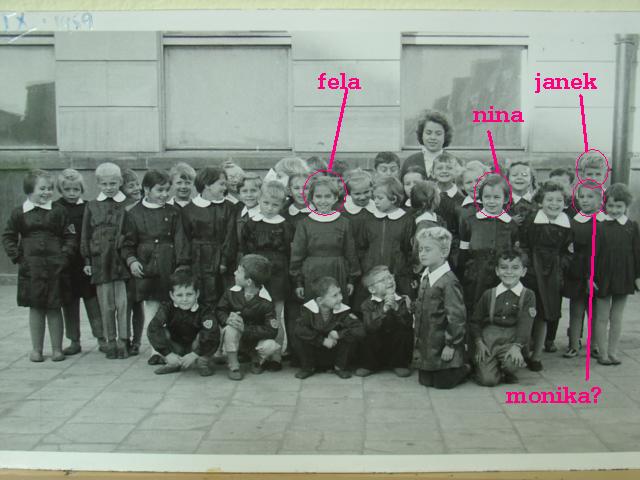
In the meantime, I am trying to pick out Monika from my first grade photo below (taken in 1959; click to enlarge). Only one of the faces seems potentially fitting. Circled also are the faces of Fela (post from last Friday on ‘Politics at the Personal Level’), Janek, and myself (the school ‘monitor’, of course!).


Warsaw Elementary School no. 43, first grade Posted by Hello

You THINK you’re in a sea of strangers…

I ran into someone at the store this afternoon. I know this person, I thought. I know quite a bit about him. I know something of his family life, his travels, in fact I know where he ate dinner recently. On the other hand, he knows me not at all. If I introduced myself, he would not recognize my name. He would stare blankly at me and say something like “sorry, I don’t believe we’ve ever met.”

It’s odd that there are these imbalances of information out there. Because on other days, the flip side of this must happen too – where I am in ignorance of the fact that the person standing next to me knows all sorts of details about me as I innocently go about picking strawberries or granola.

With so many former students remaining in Madison after Law School, the probability of someone recognizing me and me not them is high (it happened just today at the Farmers’ Market). Still, prior to the blog, the amount of information that they would have about me would be limited, for the most part, to what I said in class or in my office. Though not always. It’s a small town and people pass all sorts of stories about others. Teachers are a good target for this kind of talk, I’m sure.

But today was different. I was the one tipping the informational scale. In the end it felt strange to say nothing and so I did introduce myself as one who knew him in this odd one-sided way. Which freaked him out completely. Next time, I think I’ll just grin knowingly. At worst I’ll appear excessively friendly, perhaps deranged even. But I wont cause such great discomfort as I did today, when I said “you don’t know me, but I sure know YOU.”

Saturday, June 12, 2004

How a Country Defines its Heroes, then Changes its Mind and then Changes its Mind Again

There was a time when Lech Walesa was every person’s good guy. In Poland, he was, of course, the symbol of change, the leader of the quiet revolution, the one who linked different factions to form an effective, cohesive movement, transforming the country, transforming the continent of Europe. And that’s not an overstatement.

Then he became the President of Poland. That was tougher: skills that he had brought into Solidarity weren’t necessarily ones that would benefit him as the leader of the reemerging democracy. Poles were less generous with their praise for the Walesa of the 1990s.

Eventually, Walesa lost much of his political clout and now he is just one of many voices commenting on the political and economic climate in Poland. His words no longer astonish, nor are they even on par with the voices of other commentators who are far better educated, well-read, critically sharp in their insights. Still, Poles are tolerant of maverick voices and they have a special fondness for this one – especially now that it no longer is sounded from a position of authority. As memories of his governance fade, his stature as history’s great man again begins to be felt.

Yesterday, Walesa publicly expressed his views on the Ronald Reagan era. Myself, I wish he’d sit quietly and say less. I am not so enamored with people who fail to recognize that current events have moved rapidly forward, leaving them permanently at the margins of the new political reality. Perhaps that’s a cruel way to dispose of heroes. But it is the special confluence of events that favored Walesa’s rise to prominence. And it is the ordinary progression of events that has pushed him aside. That’s the way things work in political life, isn’t it?

Walesa’s letter eulogizing Reagan (reprinted yesterday in WSJ.com) is a great example of one man without a clue about the complexity of events commenting on another who once held an equally limited grasp of the entirety. How telling that Walesa, in this article, also includes in the handful of great world leaders such progressive ‘visionaries’ as Margaret Thatcher and John Paul II. Reagan, Thatcher and the current Pope. What a club!

Generous that I remain toward Walesa of the 1980s (and I am very very generous), I cannot stomach his comments on these figures from the past. Marveling at Reagan’s commitment to such values as basic human rights, Walesa writes:

I often wondered why Ronald Reagan did this, taking the risks he did, in supporting us at Solidarity, as well as dissident movements in other countries behind the Iron Curtain, while pushing a defense buildup that pushed the Soviet economy over the brink. Let's remember that it was a time of recession in the U.S. and a time when the American public was more interested in their own domestic affairs. It took a leader with a vision to convince them that there are greater things worth fighting for. Did he seek any profit in such a policy? Though our freedom movements were in line with the foreign policy of the United States, I doubt it.

Not grand enough yet? Consider this, then, further into the article:
…(Only one group of politicians is) convinced that there are values worth living for, and even values worth dying for. Otherwise they would consider their life and work pointless. Only such politicians are great politicians and Ronald Reagan was one of them.

And a reflection on how a Pole would regard a cowboy:
Cowboys in Western clothes had become a powerful symbol for Poles. Cowboys fight for justice, fight against evil, and fight for freedom, both physical and spiritual.

Really, enough already. Bringing back heroes isn’t always such a good thing. I am forgiving of Walesa’s missteps as President, but only if I don’t have to hear him speak now, because his words only serve to remind me that greatness can be easily lost if we keep on talking when we no longer know what we are talking about.

The World of Markets and Restaurants, continued

If these colors don’t send you into a state of ecstatic rapture, you are one tough reader to please.


It was one of those days where the lazier you were, the better off you wound up being. Early marketers had the gloom, the chill, the fog. Late risers had the sunshine, the music and plenty of foods and flowers left to choose from.

I filled L’Etoile’s cart several times over. The best part? People watching at the Market. The worst part? Let’s just say the chilly wee early morning and let it go at that.

I did also hang out for a bit in L’Etoile’s kitchen. At this time of the year, even standing in the walk-in cooler is pleasant – the little refrigerator-room smells of everything that’s fresh and wholesome. (In the later months of the summer, the walk-in is greatly loved for another reason: it’s a place of respite from the horrible heat of the ovens conjoined with the horrible heat of the season. Did I say this before? L’Etoile is the only high-end restaurant I know of that does not have air conditioned kitchens. It is HELL there during the summer.)

The cook was working on the Vesuvius dessert prep. More precisely, it is the ‘Chocolate Vesuvius with Dark Chocolate Truffle, Red Currant Cassis Coulis and Vanilla Crème Anglaise.’ Many places these days make a Vesuvius-type dessert (including Chili’s!), but L’Etoile’s really is at the top – though only if the morning cook remembers to grease the forms well enough so that the final product slides out and doesn’t create a crisis for the sweating, harried night cook. Nothing, NOTHING flares the temper more than one stuck Vesuvius, at a time when all other desserts are ready to go.


nice and greasy Vesuvius forms Posted by Hello

Friday, June 11, 2004

Politics at the most personal level: Living through something you do not fully understand

Sometimes I think we don’t use the words “I’m not sure” often enough. We have too much confidence, too much belief in our own choices and interpretations. We think ourselves to be above malice (‘it’s everyone else, never me’), above repression (‘I like differences, in theory’), to be generous and peace-loving (‘I avoid conflict, it’s everyone else that invites it’), believing in what we want to believe in (‘I’m incapable of being unkind; war is necessary; my country does it right’).

When I was very very young, I went to a birthday party of a classmate (this was in Warsaw, Poland). It wasn’t a well planned event (American families put lots more effort into children’s parties) and so the kids got restless. Soon, the activity of choice was to search in the flower pots for bugs and to transfer them into the hair of Fela Fastman. Why pick on Fela Fastman? Why indeed. Many many years later, it was suggested to me that she was often made fun of because she was different. She was Jewish.

In high school, I had a close friend named Malgosia. She and I recently found each other through email. She writes this about her last high school weeks (roughly translated): Do you remember our end-of-year prizes? How the teachers gave me mine and Felek his behind the scenes? How the principal would not recognize us publicly because we were Jewish?

I did not remember. In fact, I had not even known that Felek was Jewish. Malgosia said that she hadn’t known either until that last day of school.

In the turbulent political climate of the late 60s, I joined ZMS, which was the Union of Socialist Youth. Among liberal Poles, I later found out, it was considered a repressive organization, parroting the party line, avoiding all the difficult questions. I did not know that when I joined. I thought it to be full of energetic idealists, the doers, the movers, the ones that wanted to work together to accomplish worthy goals. I un-joined later.

One spring, I walked home from high school (in Warsaw) by way of the School of Engineering. I’d heard there were students out in the streets, marching in protest against recent government decisions. I knew by then that the students were on the side of reason. I knew. As I got closer, I noticed that it was no longer a peaceful march. I did not know that my very presence there put me in danger and so I did not see the police running toward me, I did not anticipate being repeatedly clubbed and beaten by them (so much so that I needed a hospital visit).

Not to know, not to see, to live in political and personal ignorance, not to engage in questioning, to accept as hard facts what you’re told by friends, politicians, those around you. To hang on to your own implacable vision of the world as if it could never be improved on. Or changed.

Adam Michnik, perhaps the most influential former Polish dissident, wrote an impassioned article in the New Yorker a few years back questioning the complicity of Poles in the anti-Semitism that has haunted the country for many decades. The occasion for this was the publication of a book by Jan Gross that detailed the massacre of fifteen hundred Jews in Jedwabne during WWII, not, as was originally believed, by the Nazis, but by the Poles living in this northeastern corner of Poland. Many Poles found the accusations to be slanderous and reprehensible. (For more info on this, see this website.) But the evidence is compelling.

In the article, Michnik implored everyone living in the 50s, 60s and 70s in Poland to look back and accept responsibility at the very least for the ignorance that was ours during this period – ignorance about our present and about our past.

It seems so much of this still has application, here, everywhere. Because we still live as if we know, even though we know and understand little. We act as though we are moral and just whereas oftentimes we’re neither. We don’t waffle, we don’t admit to errors, we don’t search out new evidence. And we don’t accept responsibility for our ignorance. We don’t even recognize it as such.

I’ve been meaning to write this post for a while. It’s been weighing on me.

What my mother thinks I should know about

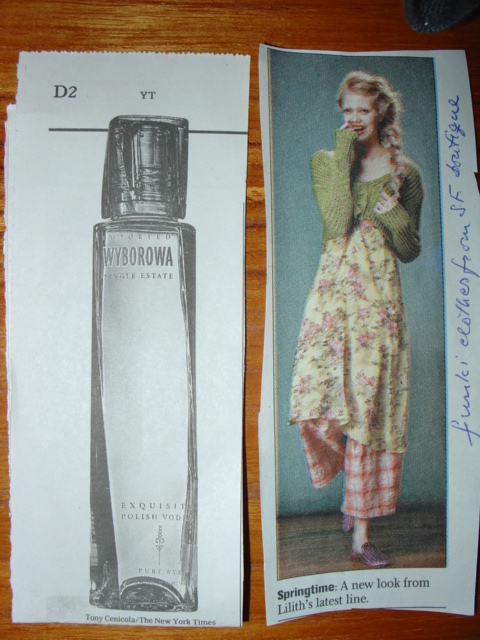
My Berkeley clipping service (aka my 80 year old mother) sent me a thick batch of newspaper articles this week. Among other items I find a piece on Sedaris (that makes sense – he is the hot author of the moment and my clipper wants to make sure I’m up on the new literary icons), an article from the Sunday Times on Warsaw (even though she knows I get the Sunday Times, so how could I have possibly missed it?), a piece on the Bush daughters and Chris Heinz (she is of the generation that loved tracking political families), and then the following two cuttings:


important information Posted by Hello

On the left, you see a new design for a Vodka bottle. On the right is a woman dressed in some youthful garb (it comes with the scribbled note ‘funki clothes from S.F. boutique’). What hint is there in this? That I am too conventional? Or that I live in a part of the country where people would not have the imagination to dress in this way? Or, oh my God, that this is the new style of clothing that she has come to adopt for herself? And the Vodka bottle – I don’t much care for Vodka, but it is Polish after all. Should I buy it? Praise it? Show it off to others? Looks like a perfume bottle to me… What was my mother thinking?

Weblog, not wobble, wabble, bulg or bloop


This morning I went for a long, wet, buggy (there's no escaping it) walk with a friend whom I hadn’t seen for many months. In catching up with our lives, I naturally felt compelled to tell her about blogging. ‘What’s that?’ she asks. And so I describe it in the usual manner: I explain what it is NOT. No, it’s not a journal. No, I never skip a day. No, no, I am the sole author of it, no one else weighs in. Though they do in other blogs. Sometimes. And so on.

Why is it that Merriam-Webster online offers so little help here? Look up ‘weblog’ and you’ll be redirected to wobbling or wabbling. For ‘blog’ you may be told to switch the spelling to blob or bloop. Wonderful.

How is it that such a vast majority of the computer-using public knows nothing of blogging? Trends emerge, some disappear of course, but typically there is great fanfare surrounding them. Clothes, gadgets, we KNOW what’s capturing the collective imagination. Bloggers, on the other hand, reside in a self-sustaining world. Sometimes I forget how contained within our own circle of readers we really are.

Thursday, June 10, 2004

So many books, so what…

If it rains, then coffee shops fill and you have to look creatively for a spot to sit. At Border’s I found myself by a stack of books that I typically wouldn’t seek out. One volume in particular caused me to put my work down. This text, “Genius Moves,” explores icons of graphic design. I spent a good bit of time looking at the page where the letter “O” is used in designing ads (for example, in this one, promoting Women’s Day magazine):


…As well as at the page where the authors remind us of the power of the pointing finger. I like the way that the guilt inducing visual graphic here crosses all continents. Whether it’s Uncle Sam or the Red Army, the message is clear, they want YOU to join up.


Okay, those were the books in front of me. On my left, I have “Full Catastrophe Living” and on my right I see several shelves of intelligence and espionage narratives.

I can’t come back to this spot. How do you reconcile the search for stress reducers, with the need for lies and deception used ostensibly to attain a political equilibrium, and then read about the machinations that lay down guilt-trips so that you’ll purchase something, or worse, commit an entire life to a concept?

Forget this place. Next time I’m back with the cinnamon buns, scones and biscotti at the coffee shop. If I stand over someone long enough and point a menacing finger, maybe it’ll guilt trip them into relinquishing a seat. Eventually.

That Polish Spirit

In a recent (and as is typically the case for this blogger, both funny and sagacious) JFW post I am referred to as having the old Polish make-do?-can do!-spirit. Well yes, true enough. I tend toward the belief that if you poke that stick around the riverbank, you’ll let loose a stream of inspiring possibilities, all within reach, just a tweak here and you got it! You’re coasting! Yes, even if you're stumbling, it’s all doable, yes yes, no need to hold back!

But that spirit is embedded in an equally Polish trait: we are a contemplative lot. We take our promenades through parks and forests seriously. We know how to search out moments of calm. Here’s mine, learned at an early age (though what’s with the two fingers? must I always invent my own convention?).

Wednesday, June 09, 2004

Lobsters

I read today (Gourmet Magazine, May issue) that it is now illegal to kill lobsters in Reggio Emilia, Italy, by thrusting them headfirst into a pan of boiling water (a regulation to that effect was passed this March and it holds true for both the home cook and the restauranteur).

I hate cooking lobsters because it is the only food preparation that requires me to actively participate in causing a living thing to cease living under my guidance. I tell myself that the lobsters are living an existence in their tanks that has to be tantamount to hell, but it is a small comfort.

Still, I have long reconciled myself to not being a vegetarian. But I am a meat-fish eating person who wants the food I consume to be treated in a humane manner prior to my consumption of it (absurd? Maybe, but I am absolutely committed to this) and so I eat only free range poultry and meats and I avoid farmed salmon unless I know it’s farmed in ways that are in accordance with principles of sustainable fishery practices.

So where does this put me with lobsters? Do we KNOW that it is less humane to plunge them into the pot headfirst? If so, I will stop doing this immediately (on the rare, rare occasion that I cook lobsters). But what is the more humane alternative? Should I ask the governing officials of Reggio Emilia? Does it matter that they are a landlocked municipality? How is it that they deal with their pork and poultry?

Ah, the Italians! So often they govern with their hearts! Consistencies be damned.

It’s good to move things around every once in a while

Another round of applause for the talented Mr. F who can now do blog template tricks efficiently and well. Redecorating the blog has never been easier. Especially for me, who has done little beyond issuing directives. Sometimes it’s good to know nothing about something.

Conformity

Is it every girl’s wish here to be like the others? I just read a student blog that made me go back to this and think more about the pressure to conform. Because in truth, I do not remember this about my own past. My best recollection is that I was not bothered by my Polishness here (even at the height of the Cold War period and even though it meant that I came from a very poor country), about my years of spunk-verging-on-tom-boyishness, about my non-Catholicism back in Poland, etc. I’m still not particularly bothered by being outside of the mainstream in a number of my daily orbits. It may strike some as odd that I moonlight in a restaurant or write mini-essays in a blog (which does not aspire to be a blawg) or think it cool to clean my own gutters and watch cheesemakers form perfect rounds of Camembert or to hang out with people that are age-wise or otherwise different from me, like, for example students (with whom I have pretty much nothing in common) from the conversation class at the Kanzaki Cultural Center in Japan. I don’t aspire to oddities but I certainly don’t run from them.

Yet, sometimes I wonder if I am completely honest here. Because I do notice differences. For instance, in the last week of first grade (in my Polish elementary school), the girls were told to come to school dressed as fairies and princesses for an end-of-year celebration. My mother was not one to indulge little fantasies of gauze and petticoats and so she told me to just wear my best dress. Let me not count the number of ways in which I stand out in this photo (down to the odd way that I am holding onto my skirt). On the other hand, I do not recall being bothered at the time.


Sometimes I think there is a funny reversal of attitudes toward conformity here and in the Poland of my youth. Here, the preoccupation with individual rights is completely evident at every juncture (whereas in Poland, the collective good was, of course, at the forefront of political discourse). On the other hand, I notice that the vast majority of kids fight individuality and favor conformity all the way through their growing years in the States. To stand out appears to be the kiss of death. Only if you feel yourself to be beyond hope do you then jump ship and begin to intensely accentuate your strangeness.

I can’t say that I remember this to be the case in my Polish environment. It’s as if our collective conscience was saturated and we privately valued independence and uniqueness. Kids (yes, even girls) that stood out in high school because of their smartness or talents or peculiar backgrounds or interests weren’t shunned for it (I’m going to exempt religious diversity from this gross generalization – the specter of anti-Semitism in post-war Poland is a topic I intend to address in a later blog).

Even at the very basic level of appearance, tolerance for the odd was high (for instance, I had several years of skin issues that would cause anyone here angst to the max yet I was extremely socially active; friends had body odor since levels of hygiene were mixed and deodorants were unavailable; others had lousy clothes; one girl was extraordinarily obese for medical reasons yet for a long time she dated one of the hot guys in our class and btw, he was ‘hot’ even though he stuttered).

My high school had some of the more together students as it was right in the city center and many families living there had deep urban roots with an above-average commitment to education. Yet, perhaps at a deeper level, we all understood ourselves to be losers as well (Poland is a country with one huge complex, broken down into a thousand other, smaller complexes) and so our empathy for the tainted trait in another was high.

As for our forays into the world of nonconformity -- perhaps our similarities bored us and our streaks of individuality provided an excitement and a diversion. It was not a bad way to move through adolescence.

This week means graduation for all of Madison’s high school seniors. Such privileged students they are compared to my Polish peers from the class of 1969 (that would be 35 years ago: gulp..)! But really, I can’t say that we had the rougher go of it. We were bonded, down to the last misfit in our class. Is there a better way to survive the school years?

Tuesday, June 08, 2004

It was so warm today...

...that you just wanted to wrap yourself around a tree and collapse.

Conversation from earlier in the day

kr (kind reader): Why wont you go with us to the Simon & Garfunkel concert in Milwaukee? I thought you liked Simon & Gurfunkel.
nc: I do like them. I just don’t like concert crowds.

kr: Wait a minute! Didn’t you say you enjoyed Lilith Fair? Dar Williams? Indigo Girls? Didn’t I read something here about you and the Rolling Stones?
nc: That was then. Now, transport all that music, any music for that matter, into a nice atmospheric café or music club and you’ll find me there. But not at a mass concert that draws millions.

kr: You are inconsistent! You say you like to be around people. You talk all the time about looking for communities of people!
nc: I mean by that a manageable group of people, the numbers of which don’t tax my counting capabilities.

kr: But you go to non-pop music concerts in large halls..
nc: It’s civilized in those halls. Sometimes too civilized. As in fall-asleep-civilized. But civilized nonetheless. At pop music concerts I feel everyone is poised to attack – the singers, each other, anything in the line of fire.

kr: You never struck me as the nervous nor the quiet type.
nc: Correct, I am neither. But those places can be TOO LOUD and that can make me NERVOUS.

kr: You have again managed to make so sense.