Thursday, July 08, 2004
A musing
Occasionally, in a moment of musing about your past, you google a memory. Indeed, this is what must have happened, as I got the most remarkable email today from someone who reached this blog by googling the lyrics to the “United Nations” song that I used to love so much back in my elementary school days at the UN International School.
The reader writes: I googled "United Nations on the march" and found the lyric at your site. As a youngster at a bungalow colony day camp in the Catskils in the 1940s we sang the song. Sadly, I haven't heard it since.
This, then, is the power of the blog. It allows you to get close to people over “blogger dinners.” It allows for friendship to grow exponentially. And, it allows you to talk to someone who, 20 years before your own elementary school days, was belting “Take heart all you nations swept under!” at a camp in the Catskills.
Happy bloggerversary to JFW, the blog that gave me a leg up on this blogging business.
The reader writes: I googled "United Nations on the march" and found the lyric at your site. As a youngster at a bungalow colony day camp in the Catskils in the 1940s we sang the song. Sadly, I haven't heard it since.
This, then, is the power of the blog. It allows you to get close to people over “blogger dinners.” It allows for friendship to grow exponentially. And, it allows you to talk to someone who, 20 years before your own elementary school days, was belting “Take heart all you nations swept under!” at a camp in the Catskills.
Happy bloggerversary to JFW, the blog that gave me a leg up on this blogging business.
This has happened to me!
I opened the New Yorker this afternoon to the following ad from a credit card company:

(nc: poor Glenna -- she takes the plunge and then gets mocked for it by a credit company!)
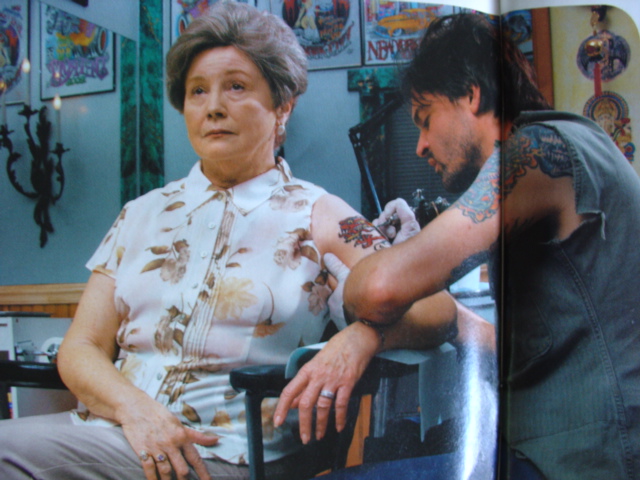
Alongside the photo were these words: It didn’t seem right to us, either. We thought it a little odd that Glenna from Duluth would spend $282 at the Screaming Needle in Hollywood. With Fraud Early Warning, XX can recognize unusual spending and stop it.
Now wait a minute! There is a clear insinuation that a 50 + (okay maybe a bunch of pluses) woman living in Duluth is staid and priggish and that she lacks an irreverent side that would cause her to hop on a plane to LA and get herself a tattoo.
Maybe. I don’t know Glenna. But then, does XX Company? And what else do they know about Glenna? Is there a person who goes through her every receipt and says “Yep, that fits, that’s Glenna!” or “No way would she buy something so gauche, so risqué, that Glenna, she’s no spring chicken now is she? And from Duluth, too.”
I’ve had my card rejected in places and so I know the feeling. I have been warned by operators whom I have frantically called to avoid the embarrassment of being arrested for non-payment, that next time I would be well advised to call ahead, to warn the company of impending odd expenses in weird and out-of-the-way places. It’s for my own protection, after all. What, from myself??

(nc: poor Glenna -- she takes the plunge and then gets mocked for it by a credit company!)
Alongside the photo were these words: It didn’t seem right to us, either. We thought it a little odd that Glenna from Duluth would spend $282 at the Screaming Needle in Hollywood. With Fraud Early Warning, XX can recognize unusual spending and stop it.
Now wait a minute! There is a clear insinuation that a 50 + (okay maybe a bunch of pluses) woman living in Duluth is staid and priggish and that she lacks an irreverent side that would cause her to hop on a plane to LA and get herself a tattoo.
Maybe. I don’t know Glenna. But then, does XX Company? And what else do they know about Glenna? Is there a person who goes through her every receipt and says “Yep, that fits, that’s Glenna!” or “No way would she buy something so gauche, so risqué, that Glenna, she’s no spring chicken now is she? And from Duluth, too.”
I’ve had my card rejected in places and so I know the feeling. I have been warned by operators whom I have frantically called to avoid the embarrassment of being arrested for non-payment, that next time I would be well advised to call ahead, to warn the company of impending odd expenses in weird and out-of-the-way places. It’s for my own protection, after all. What, from myself??
Cost – Benefit Analysis
Last night I attended a blogger dinner: five bloggers (representing Boring, Bed, SirEP and Ocean) sat face to face and talked about the trials and tribulations of life in the big league (of work? academia? blogging? all of the above). Why call it a blogger dinner? Why not just dinner with friends? Because this, like my dinners with Mother In Law and with A, B & F, would not have happened were it not for our blogging. Indeed, in this case, I would never have met the people at all. There is unquestionably a sizable social benefit to this blogging thing.
However, there is also a cost. I have noticed that one side effect of blogger dinners is that people feel terribly anxious about posting something about the event afterwards. It’s as if we have to be especially witty and clever and insightful, we have to stretch ourselves beyond our normal boring selves. In other words, we have to put out a spin that exceeds our capacities.
Well NOT ME! I will not let this become a permanent liability, a cost, a burden, I will lead by example, set the pace, storm ahead with a DUMB POST ABOUT THE BLOGGER DINNER!
Keep that in mind as you read my not especially profound observations about last night:
1. It was one of those interesting situations where you’re sitting there waiting and only one other person shows up. Many minutes pass and still it’s just the two of you. You wonder, have I posted something recently that offends? Did they all get pulled over by a police car and are now talking themselves out of a jail sentence for speeding? What? [ans: the latter.]
2. This was a sober bunch. It’s been a while since I’ve been out with a group of people where the dominant and most popular drink was water. I did not cave in to peer pressure. I stayed with my rule that if it’s a dinner where the entrees cost more than $5.99 per plate then there should be wine.
3. Talk fast or be prepared to move when the waiters start putting up chairs on tables, hinting that you’re overstaying your welcome. It’s Madison: the chairs on tables routine begins at 10. What would this town do without the Barnes & Noble café, which stays open until 11…
4. My devious subtle testing revealed that the bloggers have been reading Ocean. They knew, for instance, that I had misspelled “hardy peasant stock.” [it appears as “hearty” in the blog – something that I affectionately preserve only in part because I don’t retro-edit posts that are more than a day old.] Or, they were good at faking it.
5. The bloggers I met are terrific. They are witty and smart and funny and cool. The lesson: if your blog is good, you’re no dork.
6. A photo. There must be a photo. The Ocean rep took it and so she is missing from the pack. The rest-- here they are, the whole boring, beddy, sirepy bunch of them:
However, there is also a cost. I have noticed that one side effect of blogger dinners is that people feel terribly anxious about posting something about the event afterwards. It’s as if we have to be especially witty and clever and insightful, we have to stretch ourselves beyond our normal boring selves. In other words, we have to put out a spin that exceeds our capacities.
Well NOT ME! I will not let this become a permanent liability, a cost, a burden, I will lead by example, set the pace, storm ahead with a DUMB POST ABOUT THE BLOGGER DINNER!
Keep that in mind as you read my not especially profound observations about last night:
1. It was one of those interesting situations where you’re sitting there waiting and only one other person shows up. Many minutes pass and still it’s just the two of you. You wonder, have I posted something recently that offends? Did they all get pulled over by a police car and are now talking themselves out of a jail sentence for speeding? What? [ans: the latter.]
2. This was a sober bunch. It’s been a while since I’ve been out with a group of people where the dominant and most popular drink was water. I did not cave in to peer pressure. I stayed with my rule that if it’s a dinner where the entrees cost more than $5.99 per plate then there should be wine.
3. Talk fast or be prepared to move when the waiters start putting up chairs on tables, hinting that you’re overstaying your welcome. It’s Madison: the chairs on tables routine begins at 10. What would this town do without the Barnes & Noble café, which stays open until 11…
4. My devious subtle testing revealed that the bloggers have been reading Ocean. They knew, for instance, that I had misspelled “hardy peasant stock.” [it appears as “hearty” in the blog – something that I affectionately preserve only in part because I don’t retro-edit posts that are more than a day old.] Or, they were good at faking it.
5. The bloggers I met are terrific. They are witty and smart and funny and cool. The lesson: if your blog is good, you’re no dork.
6. A photo. There must be a photo. The Ocean rep took it and so she is missing from the pack. The rest-- here they are, the whole boring, beddy, sirepy bunch of them:
Wednesday, July 07, 2004
too much text, too little color
In late winter, I would post spring updates here, pulling photos off the web to illustrate where my garden was heading. Then I stopped. There was so much color elsewhere that I did not need to sprinkle the blog with garden photos. But today I noted paragraph after paragraph of blog text and decided it was time to jazz it up some with flowers from my garden. They thrived this year on neglect. I hardly tended them. Reliably, they came back to show off their true spunky grit and spirit.
Why I stopped going to yoga
Some of the reasons:
1. working out in 98 degree heat was so…toasty.
2. my “all you can yoga in a week for $14” deal ran out.
3. because I have a suspicious nature and I look dubiously at meditative exercises that you can do with your dog. No, not a mistype. Dog. In a BBC article that I picked up off of someone’s blog (sorry, I can’t come up with the link to the blog, but here’s the link to the article) I read that people are now bringing their dogs to yoga classes. The dogs seem to love the various yoga positions and do them effortlessly, almost, in fact, as well as their owners.
Ridiculous? Yes! Especially the part where they all breathe together and hold paws. Read this:
The dogs did most of the things that the humans did. "At the end we were even encouraged to get them to hold their paws together so that we could recite a specially adapted concluding prayer.”[-- this from one of the owners.]
I am willing to see well-behaved French dogs in restaurants with their owners, but somehow extending the imagination to canine yoga is too much of a stretch. Really.
1. working out in 98 degree heat was so…toasty.
2. my “all you can yoga in a week for $14” deal ran out.
3. because I have a suspicious nature and I look dubiously at meditative exercises that you can do with your dog. No, not a mistype. Dog. In a BBC article that I picked up off of someone’s blog (sorry, I can’t come up with the link to the blog, but here’s the link to the article) I read that people are now bringing their dogs to yoga classes. The dogs seem to love the various yoga positions and do them effortlessly, almost, in fact, as well as their owners.
Ridiculous? Yes! Especially the part where they all breathe together and hold paws. Read this:
The dogs did most of the things that the humans did. "At the end we were even encouraged to get them to hold their paws together so that we could recite a specially adapted concluding prayer.”[-- this from one of the owners.]
I am willing to see well-behaved French dogs in restaurants with their owners, but somehow extending the imagination to canine yoga is too much of a stretch. Really.
A long post that spans such topics as Croatian Rockefellers, the Medicis of Florence, Nobel laureates and Polish restaurateurs
Over the years, scientists, entrepreneurs, artists have left their home countries to travel to places where labs are well funded and opportunities to prosper are numerous (mostly in the U.S.). With respect to men and women of science, today’s IHT describes the phenomenon (here) thus:
The world's scientists are like a flock of flamingos that migrates from briny lakes when they dry up and returns only when the lagoons are replenished.
Not surprisingly, many of the home countries, including Poland, are now trying to woo the successful scientists back to their homeland. In Italy and Croatia large-scale research centers are being established to entice those who have left. And the successful expatriates who have made their wealth abroad are being asked to donate large sums of money to keep the centers competitive with their counterparts abroad.
I find the idea of returning in some way to your base, aligning yourself again with your home country, infinitely fascinating. Radman, a Croatian scientists who heads a 25-person lab in Paris, has taken it upon himself to secure donations from fellow expats for the Mediterranean Institute for Life Sciences on the Adriatic Coast. In the article, I read:
“I'm trying to tempt them to play the role of Croatian Rockefellers or the Medicis of Florence," he said. The sales pitch isn't flowery: "What will you get in return? Nothing. Just the glory."
I think there are two types of success stories out there – the Martha Stewart types who do much to camouflage their heritage, even changing their names to Americanize their image (I suppose the title “Martha Kostyra Living” lacks a certain pizzazz; and in all fairness, she was not born in Poland and so her associations are a generation removed from her roots), and then there is the very large second group whose members cannot or will not break with their past. In it we have the musicians – the Chopins and Paderewskis who left and died abroad, but went back again and again in their work to their homeland (Poland); or, we have the “fathers” and “mothers” of disciplines who returned to Poland in significant ways in their scholarship: there is Florian Znaniecki, author of the “Polish Peasant,” a work that I think, can fairly be described as creating the foundations for empirical sociology; Oscar Lange, who, after a successful career in economics at Chicago, went back to Poland and lay the groundwork for the emergent field of Econometrics; or Marie Sklodowska Curie, who named a newly-discovered element after her homeland (“polonium”).
The last I counted, there were some two dozen Nobel Laureates who are either Polish or of Polish origin. Of course, everyone knows about Walesa, Milosz, Szymborska, or even Singer (all Nobel laureates), but does anyone know that the following are also Poles by birth? – Begin (Peace, ’78), Peres (Peace, ’94), Rotblat (Peace, ’95), Agnon (Literature, ’66 – maybe the fact that Poland was partitioned during his childhood caused him to not think in terms of having a homeland), Grass (Literature, ’99 – he, too, said nothing about Poland in his Nobel prize acceptance speech; even in speaking of his childhood and early influences he managed to skip any references to things Polish) and a host of scientists that are not household names here or in Poland. None of these are significantly focused on their country of birth.
On a less grand scale (and belonging to the group of returnees), I met this winter a Polish-French woman who married a French chef and convinced him to open (along with her) a restaurant in Krakow (even though he speaks hardly a word of Polish). She relocated her family to Poland (she had left the country when she was a child), excited at the idea of riding a wave of success there. She told me she wants to be part of the newest “Polish renaissance.”
It’s all intriguing to me – the story of the returning Pole, in spirit or otherwise, the one who can’t quite let go of the past.
The world's scientists are like a flock of flamingos that migrates from briny lakes when they dry up and returns only when the lagoons are replenished.
Not surprisingly, many of the home countries, including Poland, are now trying to woo the successful scientists back to their homeland. In Italy and Croatia large-scale research centers are being established to entice those who have left. And the successful expatriates who have made their wealth abroad are being asked to donate large sums of money to keep the centers competitive with their counterparts abroad.
I find the idea of returning in some way to your base, aligning yourself again with your home country, infinitely fascinating. Radman, a Croatian scientists who heads a 25-person lab in Paris, has taken it upon himself to secure donations from fellow expats for the Mediterranean Institute for Life Sciences on the Adriatic Coast. In the article, I read:
“I'm trying to tempt them to play the role of Croatian Rockefellers or the Medicis of Florence," he said. The sales pitch isn't flowery: "What will you get in return? Nothing. Just the glory."
I think there are two types of success stories out there – the Martha Stewart types who do much to camouflage their heritage, even changing their names to Americanize their image (I suppose the title “Martha Kostyra Living” lacks a certain pizzazz; and in all fairness, she was not born in Poland and so her associations are a generation removed from her roots), and then there is the very large second group whose members cannot or will not break with their past. In it we have the musicians – the Chopins and Paderewskis who left and died abroad, but went back again and again in their work to their homeland (Poland); or, we have the “fathers” and “mothers” of disciplines who returned to Poland in significant ways in their scholarship: there is Florian Znaniecki, author of the “Polish Peasant,” a work that I think, can fairly be described as creating the foundations for empirical sociology; Oscar Lange, who, after a successful career in economics at Chicago, went back to Poland and lay the groundwork for the emergent field of Econometrics; or Marie Sklodowska Curie, who named a newly-discovered element after her homeland (“polonium”).
The last I counted, there were some two dozen Nobel Laureates who are either Polish or of Polish origin. Of course, everyone knows about Walesa, Milosz, Szymborska, or even Singer (all Nobel laureates), but does anyone know that the following are also Poles by birth? – Begin (Peace, ’78), Peres (Peace, ’94), Rotblat (Peace, ’95), Agnon (Literature, ’66 – maybe the fact that Poland was partitioned during his childhood caused him to not think in terms of having a homeland), Grass (Literature, ’99 – he, too, said nothing about Poland in his Nobel prize acceptance speech; even in speaking of his childhood and early influences he managed to skip any references to things Polish) and a host of scientists that are not household names here or in Poland. None of these are significantly focused on their country of birth.
On a less grand scale (and belonging to the group of returnees), I met this winter a Polish-French woman who married a French chef and convinced him to open (along with her) a restaurant in Krakow (even though he speaks hardly a word of Polish). She relocated her family to Poland (she had left the country when she was a child), excited at the idea of riding a wave of success there. She told me she wants to be part of the newest “Polish renaissance.”
It’s all intriguing to me – the story of the returning Pole, in spirit or otherwise, the one who can’t quite let go of the past.
Update on the V.I.P.P.
The missing very important piece of paper (VIPP, see post about it yesterday) is still missing. One moment it was on the counter, the next moment it’s gone.
A reader writes:
Nina,
you have to stop looking for the VIPP. it's time to give up.
a concerned friend,
Tonya B
p.s. did you look in the car?
My response:
I know I have to stop this! But what if it was important? It looked SO important! I checked all cars. The last (and not altogether impossible) theory is that the dog ate it.
p.s. Just in case, I’m not letting go of the garbage today (it’s garbage pick up day on my block). I’m going to dump it all on the driveway as soon as the weather improves and go through it that way. Next, I'll recruit others to help search. They may see something I missed. I may do a dinner party around this theme…It’s here SOMEWHERE, just give me a little more time before I settle for the dog theory.
NOON UPDATE:
p.p.s. thanks, too, sir ep for your words of concern.
A reader writes:
Nina,
you have to stop looking for the VIPP. it's time to give up.
a concerned friend,
Tonya B
p.s. did you look in the car?
My response:
I know I have to stop this! But what if it was important? It looked SO important! I checked all cars. The last (and not altogether impossible) theory is that the dog ate it.
p.s. Just in case, I’m not letting go of the garbage today (it’s garbage pick up day on my block). I’m going to dump it all on the driveway as soon as the weather improves and go through it that way. Next, I'll recruit others to help search. They may see something I missed. I may do a dinner party around this theme…It’s here SOMEWHERE, just give me a little more time before I settle for the dog theory.
NOON UPDATE:
p.p.s. thanks, too, sir ep for your words of concern.
Tuesday, July 06, 2004
A FAQ
I have been asked this quite a lot: “which language do you think in, Polish or English?” Possibly I have had this query levied at times when it has been painfully obvious that I was not born into an English speaking environment (so that, after listening to me, or reading something I put together in my awkward foreign-person way, a person is tempted to ask “so…do you ever at least THINK in English?”)
When I was a kid I would give this serious consideration. I would go into my head and attempt to pay attention to my thinking process. I wanted to catch myself: “ha! Wasn’t that Polish? No, I distinctly pick out an English phrase there…”
But over time, I came to believe that it can’t be done. If you think about thinking (can one do that?) you come to realize that you are always envisioning yourself in conversation with some entity. The minute someone asks which language I think in, I rivet to the language of the inquirer.
And what of the times when no one is asking? How do I, how do multi-language people in general think? It is still the case that thinking about it forces a language, typically of the environment one is in. I dare anyone to take a moment now and contemplate with some detachment how thoughts spin inside one’s head. Mind-boggling, isn’t it?
There is only one worse question out there and I get this one as well: what language do I dream in? Typically, when asked this, I just make up an answer. I’ve learned that this is far more satisfying than my convoluted diatribe on how it is impossible to recreate thinking about dreaming in the abstract.
When I was a kid I would give this serious consideration. I would go into my head and attempt to pay attention to my thinking process. I wanted to catch myself: “ha! Wasn’t that Polish? No, I distinctly pick out an English phrase there…”
But over time, I came to believe that it can’t be done. If you think about thinking (can one do that?) you come to realize that you are always envisioning yourself in conversation with some entity. The minute someone asks which language I think in, I rivet to the language of the inquirer.
And what of the times when no one is asking? How do I, how do multi-language people in general think? It is still the case that thinking about it forces a language, typically of the environment one is in. I dare anyone to take a moment now and contemplate with some detachment how thoughts spin inside one’s head. Mind-boggling, isn’t it?
There is only one worse question out there and I get this one as well: what language do I dream in? Typically, when asked this, I just make up an answer. I’ve learned that this is far more satisfying than my convoluted diatribe on how it is impossible to recreate thinking about dreaming in the abstract.
A missing V.I.P.P.
Next week, between Monday and Wednesday, I have what amounts to a nine-hour series of lectures to give on a topic that is not within my typical lecture orbit. But neither is it an impossible task, since it is on a topic that is not especially difficult for a law prof of any field to speak on. All I need is time. I am a rather meticulous lecturer. I never go into a class without comprehensive lecture notes. I don’t read them while presenting, but anything and everything that I ever say is in some way contained in the sheaf of papers that I bring with me to class. For the hours of teaching that I have before me next week I calculated that I would need 45 pages of single-spaced lecture notes.
Today is Tuesday. I told myself that I absolutely had to begin putting together my 45 page security blanket. But early in the day, I was arrested by a disconserting realization: it struck me that yesterday I left a piece of paper on the kitchen counter. It was a very important piece of paper, folded into an envelope-like enclosure with perforations on all sides. Why do I believe it to be significant? Because it came in the mail this week-end and it had “very important” written all over it. Not literally, but in the presentation. It looked so important that I pulled it out of the stack of mail and placed it on the counter as Something I Must Not Neglect.
Tonight I was attending to paperwork and I could not find this V.I.P.P (very important piece of paper). I looked through the week’s garbage three times, piece by piece, rotten piece of food by rotten piece of food. Nothing. I went through every room in the house, every stack of papers, every drawer of irrelevant trash. Nothing.
I could not stop myself. When I didn’t find it in the first round, I did a more thorough second round. Then a third. Fourth. I’m pausing before my fifth to blog, but a fifth is around the corner.
It could have been vital to my existence. Or, maybe I was wrong. Maybe it just looked important. Maybe it was an invitation to apply for yet another credit card.
As a result of this paper chase I made no inroads on the 45 page single-spaced packet of notes. I can’t decide which is more disconcerting: the fact of the missing slip of paper, or the time lost searching for it.
Daily life
Normally if I ask someone in an email “how’s it going” they respond that they are exceedingly busy and overworked and behind on their projects, etc etc. But one friend writes the following:
“we moved cows from one pasture to the next… I am going to plant june berries underneath the aspen trees…we lost our vegetables to frost last night…” and so on.
How is it that people develop these skills? Do you read books on herding cows and then just do it? What are june berries anyway? And what place in continental US has frost in June? Does it hurt the june berries?
It struck me how during the majority of my days I move within a five mile radius of my home, my actions are limited to the same ones, day in and day out and they do not include moving cattle from one pasture to another. Just as I start to feel competently self-sufficient, I am reminded that I’ve given up on growing my own vegetables because I know the local farmers do it better and I pick up few new skills from season to season.
Thank goodness we have travel to take us out of the ordinary. Daily life can leave you with a rigid tunnel vision and atrophied observational skills, to say nothing of stagnant coping abilities.
“we moved cows from one pasture to the next… I am going to plant june berries underneath the aspen trees…we lost our vegetables to frost last night…” and so on.
How is it that people develop these skills? Do you read books on herding cows and then just do it? What are june berries anyway? And what place in continental US has frost in June? Does it hurt the june berries?
It struck me how during the majority of my days I move within a five mile radius of my home, my actions are limited to the same ones, day in and day out and they do not include moving cattle from one pasture to another. Just as I start to feel competently self-sufficient, I am reminded that I’ve given up on growing my own vegetables because I know the local farmers do it better and I pick up few new skills from season to season.
Thank goodness we have travel to take us out of the ordinary. Daily life can leave you with a rigid tunnel vision and atrophied observational skills, to say nothing of stagnant coping abilities.
Monday, July 05, 2004
Czy chcesz pizze?
Tonight’s dinner was pizza. With all the trepidations surrounding the painting job (see post below), I didn’t have the mind nor the muscle to think about food preparation. So I went to a local pizza place to pick up my order (I am the only one in town, in the country probably, who has never in her entire American life (they don’t do pizza delivery in Poland) ordered a pizza delivery; one quick drive will get me a pie fresh from the oven, so why would I opt for a delivery?).
I wore my “Prawa kobiet prawami czlowieka” t-shirt tonight. Most people pick the next clean t-shirt in the stack to throw on. I choose mine deliberately. I wear the Polish one whenever I miss my connections to that country. [the translation of the words is “women’s rights are people’s rights.” The shirt comes from a friend who works at the Center for Women’s Rights in Warsaw and if you knew how incongruous it is to talk of women’s rights in the Polish context, you’d appreciate how much this t-shirt means to me. It is fading considerably from overuse.]
As I claimed my pizza, the young man said to me “ty rozmawiasz po Polsku?” He had a slight American accent, but he was otherwise quite fluent (translation: you speak Polish, don’t you?).
It turns out that he is a Wisconsin guy who had decided, while in college at UW-Stevens Point, to learn Polish. Eventually, he spent his junior year in Poland. Okay, so he is now dishing out pizza – not a great ad for choosing Polish as you major. But I’m sure he’ll move on to bigger and better things any day now.
I have, until this day, in my many years in this country, met only two people who had had no connection to Poland but had decided to learn the language nonetheless. Both were sociologists who chose to do research in Poland. This young man today will make it a pack of three who will have deliberately studied Polish.
I asked how it could be that he spoke Polish so well. The language is exceedingly hard for Americans, in part because of the conjugation principles (you conjugate nouns as well as verbs, so that if you say “I sit on top of the table” or “I sit under the table,” the word “table” will take on a different form; this additional grammatical idiosyncrasy drives English speaking people completely nuts). He answered simply “jestem bardzo inteligentny” (=I am very intelligent). Indeed!
I wore my “Prawa kobiet prawami czlowieka” t-shirt tonight. Most people pick the next clean t-shirt in the stack to throw on. I choose mine deliberately. I wear the Polish one whenever I miss my connections to that country. [the translation of the words is “women’s rights are people’s rights.” The shirt comes from a friend who works at the Center for Women’s Rights in Warsaw and if you knew how incongruous it is to talk of women’s rights in the Polish context, you’d appreciate how much this t-shirt means to me. It is fading considerably from overuse.]
As I claimed my pizza, the young man said to me “ty rozmawiasz po Polsku?” He had a slight American accent, but he was otherwise quite fluent (translation: you speak Polish, don’t you?).
It turns out that he is a Wisconsin guy who had decided, while in college at UW-Stevens Point, to learn Polish. Eventually, he spent his junior year in Poland. Okay, so he is now dishing out pizza – not a great ad for choosing Polish as you major. But I’m sure he’ll move on to bigger and better things any day now.
I have, until this day, in my many years in this country, met only two people who had had no connection to Poland but had decided to learn the language nonetheless. Both were sociologists who chose to do research in Poland. This young man today will make it a pack of three who will have deliberately studied Polish.
I asked how it could be that he spoke Polish so well. The language is exceedingly hard for Americans, in part because of the conjugation principles (you conjugate nouns as well as verbs, so that if you say “I sit on top of the table” or “I sit under the table,” the word “table” will take on a different form; this additional grammatical idiosyncrasy drives English speaking people completely nuts). He answered simply “jestem bardzo inteligentny” (=I am very intelligent). Indeed!
This was supposed to be quick and easy
I have been repainting some of the rooms in the house this year. My study got the greenish-yellow treatment this winter and today I attacked a room that is mostly used as a bedroom for visitors (one such person is coming later this week). It hadn’t been painted for more than 15 years and there is an entire area where it looks like someone was systematically checking to see how many footprints could fit in a small space underneath the window.
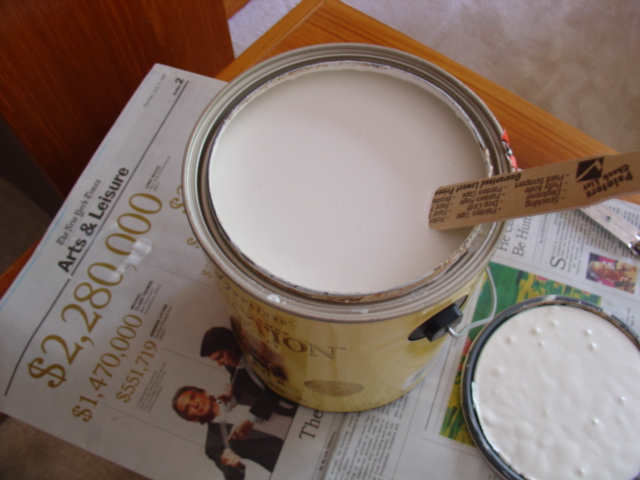
First step: get a nice creamy-toned paint. I did that back in March (it was to be a Spring Break project).

paint's ready
Second step: tape the window frames, doors and baseboards. Done yesterday.
Third step: patch holes in drywall. Yep.
Fourth step: move furniture around. Here I encountered a major snag:

wait a minute, it's not supposed to look like this
As you can see, the bed completely fell apart (actually in several places). True, it was one of those Danish teak things that isn’t terrifically sturdy and it had some years on it, but it had seemed perfectly content sitting in its spot for years and years. No one knew it had a problem until it came time to move it. Then it just sort of collapsed.
Of course, this, in the end, is a good thing. It would have been a source of great embarrassment and consternation if it had decided to fall apart while visitors were, er, sleeping on it.
Still, the painting project got interrupted by the need to purchase a new bed. All Rubin’s stores were visited, a bed was finally found. (Sixth step will have to be bed assembly; it comes in many smallish boxes; I am dubious that a full-size bed fit into these, but I am told that indeed, once the pieces are slapped, glued and nailed together, a bed will emerge.)
Fifth step: Pick up the pace with the rollers and the brushes! I am rushing to finish before the day runs out on me. I am speckled with creamy dots and dribbles (how do professional painters stay so clean when they paint?) and I anticipate at least two more disasters. Just a few minutes ago I stepped on a carelessly placed painting utensil. It took a half an hour to clean that little problem up.
First step: get a nice creamy-toned paint. I did that back in March (it was to be a Spring Break project).

paint's ready
Second step: tape the window frames, doors and baseboards. Done yesterday.
Third step: patch holes in drywall. Yep.
Fourth step: move furniture around. Here I encountered a major snag:

wait a minute, it's not supposed to look like this
As you can see, the bed completely fell apart (actually in several places). True, it was one of those Danish teak things that isn’t terrifically sturdy and it had some years on it, but it had seemed perfectly content sitting in its spot for years and years. No one knew it had a problem until it came time to move it. Then it just sort of collapsed.
Of course, this, in the end, is a good thing. It would have been a source of great embarrassment and consternation if it had decided to fall apart while visitors were, er, sleeping on it.
Still, the painting project got interrupted by the need to purchase a new bed. All Rubin’s stores were visited, a bed was finally found. (Sixth step will have to be bed assembly; it comes in many smallish boxes; I am dubious that a full-size bed fit into these, but I am told that indeed, once the pieces are slapped, glued and nailed together, a bed will emerge.)
Fifth step: Pick up the pace with the rollers and the brushes! I am rushing to finish before the day runs out on me. I am speckled with creamy dots and dribbles (how do professional painters stay so clean when they paint?) and I anticipate at least two more disasters. Just a few minutes ago I stepped on a carelessly placed painting utensil. It took a half an hour to clean that little problem up.
Is dad listening?
George W. Bush came to Cheney’s defense today. Amidst speculations that, but for the threat of the lost conservative vote, GWB would be better off dropping Cheney from the ticket, George W. responded: “Dick Cheney is the best vice president this country has ever had.” Are we witnessing a family rift in the making? Is there a lapse in memory, or a punch at dad, or what?
Sunday, July 04, 2004
Do I celebrate the 4th of July?
Though I am not a fan of nationalism of any sort, as far as holidays go, I do as the Romans do. I live here and if Americans grill things and say “happy 4th of July” to each other, why so will I. I draw the line on flag waving though.
When I lived in Poland, I celebrated the 22nd of July, but now under the new political system, that holiday is disfavored and a Constitution-related day has been labeled as THE national holiday. I go with the flow. I know that celebrating the national holidays of other countries is odd when you don’t live there and so I stick with the local stuff. I’m sure I’d celebrate Chinese New Year if I lived in Shanghai.
When I was in my twenties, I tried moving beyond parochial festivities: I made a habit of having parties on Bastille Day (I got the idea from Gourmet Magazine, of all things), but that was just odd. I would prepare French food and people would eat it, but it was otherwise a non-holiday and so in time I let go of the entire silliness.
Okay, so what does a July 4th celebration look like at the home of this Polish transplant who is not a flag-toting type and hates the bang associated with firecrackers? Well, I grill (stuff from yesterday’s market, for example). And I always make a tart. There is no reason for this except maybe one time, to be cute, I baked one with the red/white/blue concept (doesn’t everyone do this at some point in family life? How convenient that we’re in the midst of blueberry season…) and the tart stuck even if the concept went out the door.
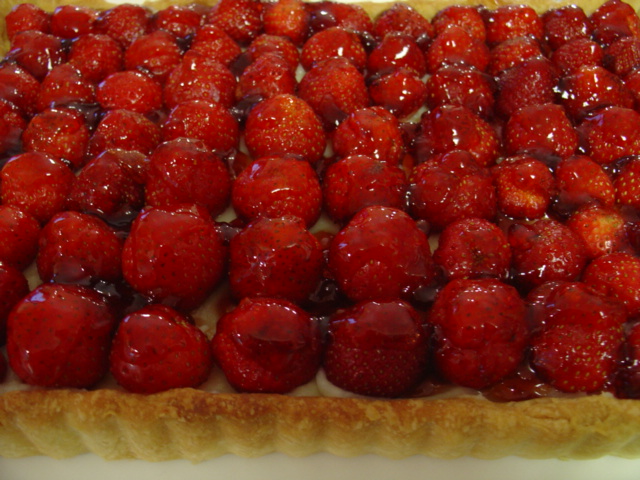
Today, I used the berries from yesterday’s market. And the currant jelly, melted over the entirety. The colors may be more Polish (red and white), but the tradition originated here, on the 4th of July.

A strawberry tart with creme patisserie and warm currant jelly
When I lived in Poland, I celebrated the 22nd of July, but now under the new political system, that holiday is disfavored and a Constitution-related day has been labeled as THE national holiday. I go with the flow. I know that celebrating the national holidays of other countries is odd when you don’t live there and so I stick with the local stuff. I’m sure I’d celebrate Chinese New Year if I lived in Shanghai.
When I was in my twenties, I tried moving beyond parochial festivities: I made a habit of having parties on Bastille Day (I got the idea from Gourmet Magazine, of all things), but that was just odd. I would prepare French food and people would eat it, but it was otherwise a non-holiday and so in time I let go of the entire silliness.
Okay, so what does a July 4th celebration look like at the home of this Polish transplant who is not a flag-toting type and hates the bang associated with firecrackers? Well, I grill (stuff from yesterday’s market, for example). And I always make a tart. There is no reason for this except maybe one time, to be cute, I baked one with the red/white/blue concept (doesn’t everyone do this at some point in family life? How convenient that we’re in the midst of blueberry season…) and the tart stuck even if the concept went out the door.
Today, I used the berries from yesterday’s market. And the currant jelly, melted over the entirety. The colors may be more Polish (red and white), but the tradition originated here, on the 4th of July.

A strawberry tart with creme patisserie and warm currant jelly
Subscribe to:
Posts (Atom)