How do I even begin to describe the pull I feel toward Sissinghurst... Let's start with this question: do you know about Sissinghurst? You don't? Let me describe its essentials.
Sissinghurst was the home of Vita Sackville-West (an author person and gardener extraordinaire) and her husband Harold Nicolson (a politician, diplomat, and also author person and gardener). They lived there from 1930 until she died in 1962 and he died in 1968. Their son, Nigel signed the property to the care and oversight of the National Trust in 1967, so that it could, well, continue to be cared for in a proper way. (Even as he stayed on, as did Vita's grandson.)
The property consists of some structures, a few crumbling walls and gardens. The Cottage Garden, the White Garden, the Purple Border -- but I'm getting ahead of myself. Because it's not just about flowers. Sissinghurst really is Vita's creation and it reflects her ideas about, well everything! Gardening to be sure: maximalist abundance! Minimalism, which I love in principle, doesn't belong in gardens. Here, bounty must rule. But Vita embodied more than just a passion for growing things. She had ideas and convictions that went against the grain of conventional life and, oh, maybe thirty years ago, I read about her, and I read her correspondence with Virginia Woolf (who was her lover for a while) and I was fascinated by it all. I always felt a pull toward those who bucked convention and I thought how it must be to let loose, at least at the edges. It's not easy to live according to your own moral compass, without fear of judgment. Of course, eventually I met Ed and with him, and with retirement, and with age, I relaxed and it became easier.
Of course, Ocean is one big stand against convention. Who do you know that publishes daily updates on life as lived over the span of decades? And doesn't care that this just isn't done? And that so many frown at this behind your back (or not behind your back)?
But there's more: Vita surrounded herself with people who stood by her despite her peculiarities, if you want to call them that. I found this intriguing: she stayed married despite her passionate affairs with women. (It should be noted that Harold also had affairs -- his with men. But from what I've read, they also adored each other.) She had two kids, and eventually grandchildren, and yet she remained her own person. And all that is reflected in the ideas that drove her to throw herself with passion into the project of creating the gardens of Sissinghurst. And writing about gardening in a way that's beautiful, unusual and quite touching.
Sometime in early spring, when I was toiling away at yet another garden expansion at the farmette -- this time pushing the Big Bed more into the courtyard -- I returned in my thoughts to Sissinghurst. I knew I'd be in Europe in August. The Poland trip. Why not stop in Sissinghurst on the return home? It proved to be a not so hard addition: a night in London, then a train ride to Staplehurst (near Sissinghurst) and then two nights at Sissinghurst Castle Farmhouse before returning home.
That's the backstory. Now for this London morning:
Breakfast in the UK is always kind of predictable. Eggs with sausage, tomato, beans, with a toast rack of once warm toast. Brown or white. Or, better yet -- porridge, which is, I think, a horrible term they use for oatmeal. At my hotel, breakfast is slow, charming, and nicely decadent (meaning croissants, berries, etc.). I choose porridge.

My train to Staplehurst isn't until 1 pm, so I ramble around a little, sticking to my neighborhood, ultimately poking into the Harrods Department Store (Ed reminded me that I need nothing and therefore should buy nothing, even if Air France can and will pay for it) and especially its Food Halls. This is a very pleasant memory for me: Harrods Food Halls were my first introduction into the exquisite world of quality food, back when I was in London more frequently because my then husband did research on intellectual movements in England of past centuries. Sure, everything in the Food Halls was too expensive for us, but I'd never quite seen anything like this before (this was back in the late 70s and early 80s). A passion and dedication to quality in food. In London of all places.

I do notice that what has happened to Harrods overall has also happened to the Food Halls. All of these food emporia are for the well heeled (pun intended). But Harrods is, in my view for the super well heeled. There are at least shelves of affordable biscuits in Paris' Bon Marche -- the French counterpart to this. In Harrods, there is nothing affordable in the whole store. (Can you tell by the photo above?)
I remember I got harshly reprimanded back in the day, for taking out my camera and trying to photograph what I saw. How times have changed...
(so British: Beef Wellington)

(so British: pigeon)

I see a Harrods uptick in poshness very quickly as I look around in the "casual" women's clothing department to pick up something I can charge to Air France when I send them my mildly annoyed letter. (The suitcase is now scheduled to arrive tonight, in London, even as I will already be gone.) I spend about 30 minutes there and I find nothing. Absolutely nothing. Not a sweater or a t-shirt -- nothing at all that I could justify as an essential replacement for things Air France is holding onto.
Not wanting to completely let go of my privileged position of great need as a consequence of their inept handling of my bag, I buy a face cream and a lipstick. Terribly expensive, but hey, these are essentials if you're without your cosmetics bag for a whole 24 hours plus, don't you think? (Receipts saved.)
Okay, time to take that train to Staplehurst. I leave instructions for my suitcase at the hotel and travel with just my tote. This fortuitous division of clothes took mega planning on my part! My Polish friends laughed that I had a list of what I would wear when, and what I would need on which day. But I had to do that! It's that or you over-pack!
And now it's time to go to Charring Cross Station. Crosssing the city as I go from my hotel to Charring Cross makes me realize that it's not just Harrods and the environs that draw crowds. London is teeming with people! So many visitors milling about! It's packed!
The Station itself, though, is great in that it has seats and the information board clearly tells you what train is pulling up where and when you can get on and what stops are on the way. Important word here: *clearly* and to be seen from all points in the big waiting room. You don't often see that in train stations (I'm lookin' at you, Madrid!).

I take the train on the comfy Souteastern line, with Wifi. Train travel has gotten a lot of disgusted and scornful press in recent months in the UK, but anecdotally, I can report that not only was Charring Cross station comfy, but it was well stocked: people enjoyed their pasties while they waited.

I bought a glossy for the ride. (Can you guess which one?)

Yes of course -- the one with the "Save the Albion Cow" headline.
(train view, moving out of London across the Thames)

My home for the next two nights is jaw-dropping awesome: it is part of the Sissinghurst estate and it was once part of Vita and Harold's orbit: the Sissinghurst Farmhouse. Right now it is of course owned by the National Trust. Sort of. The Trust owns the "brick and mortar" of the house, but they lease the inside for a ten year period -- currently it's in the hands of Richard and Anna, a couple that furnish, take care of and operate the b&b. And yes, you can walk from it right up to the gardens.
Richard picks me up at the station and we talk about Sissinghurst, the set up with the Farmhouse, their work as b&b hosts. (I haven't met anyone who likes to do this for decades upon decades; I suppose you wear out changing towels and greeting guests, especially in a place like this where the average stay he tells me is 1.5 days.)
The Farmhouse b&b:

View from my room is toward the rest of the estate:

Check in is at 4 and so I have an hour to kill. I walk over to the Sissinghurst Estate coffee shop and buy a crumble and a latte.

(In the coffee shop: the iconic photo of Vita and Harold)

And then I meander. Over to the gift shop.
Mistake.
You cannot imagine a more attractive gift shop for me than one that bases itself on these gardens, and on these writers who once lived here, and the art that they collected (think: Bristol Blue glass vases and bottles). Time flies when you're picking out cards *and such* to take home.
Outside again, I look out toward the fields: sheep, with birds on their backs...

I peak out at the entrance to the gardens and rest of the estate and talk to the ticket guard about optimal times to visit:

And then I return to the b&b to check in.
At the Farmhouse, Richard points me to the living room where they serve afternoon tea and freshly baked cakes and scones. Today it's lemon raspberry cake and scones with the whole clotted cream and jam deal. Of course, I just have to!

And I do that walk to the gardens for the first time today. The tickets person told me that the time when it's least crowded is in the last hour. The gardens close at 5:30. I'm there at 4:30 (and by the end, I have the entire huge place to myself).
First, let me include here the Elizabethan Tower, because this is what first attracted Vita to the place (Harold, on the other hand, was swayed by the nut trees) back in 1930, when she first saw it.

You can climb up to take in the views, but, too, halfway up is where Vita chose to sequester herself to write. Harold never went there. Maybe two or three times in the decades they lived at Sissinghurst. The room has no windows, but a few more steps would lead you out to see Kent's landscape unfold before you.
(And an inadequate photo for you of her room since you can't go inside it, and the Tower is narrow, so capturing the entirety or even her desk to the side is impossible...)

(along the Tower's stairwell...)

The views from the top:


I'm especially curious how the gardens fare in August, because this is a tough time for us gardeners in the northern climes. In late spring everything feels fresh, hopeful, abundant. In August it feels like you've made too many mistakes and allowed too much expansion in places where you wanted no expansion at all (phloxes, go easy on your neighbors!). Many of us basically throw up our hands and give up until next year.
So how is it in Sissinghurst?
It is at once more abundant and different than I had expected. Much more August-y. Not so much depleted, as in its "senior" phase. In Giverny, they make sure that each season explodes with color and abundance. But Vita (I read) saw this differently. She allowed her garden to transform itself as the season progressed. The National Trust follows her in this, though in some places, it has planted a few annuals -- dahlias come to mind -- to at least hint at what it's like there earlier in the summer. I'm going to post tons of pics from my walk today, but it'll be haphazard, reflecting my rather haphazard walk through it. I went where my eyes took me, ignoring the maps, the notes I had. That's the way I'll post photos today.

(Vita loved climbing roses)

(familiar to me glads!)


(a clematis, climbing a tree)
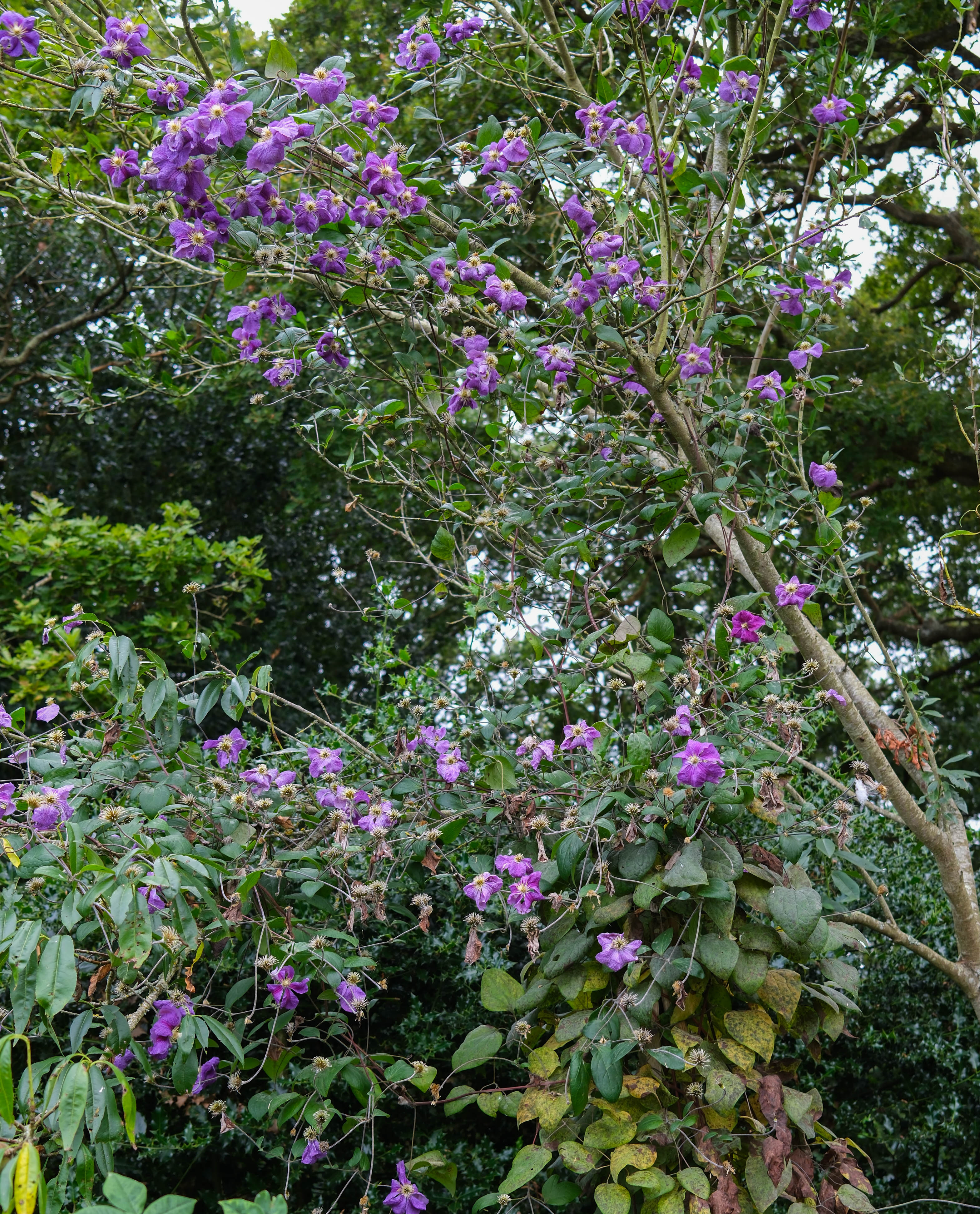
(In the last half hour, it was only him and me...)


(the White Garden is only a little white in August...)


So, was it absolutely inspiring? I think, in the end, that's the wrong word. Vita's garden and mine are hugely different, not only because she had sunshine galore (Ed! the trees! shade!), and magnificent crumbling walls as backdrops, but she also had gardeners working for her. She'd buy, they'd do the labor. (Yes, she and Harold came from wealth, and when her mother died and left her fortunes in part to her daughter, Vita and Harold put a heck of a lot of that fortune into Sissinghurst.)
But if not inspiring, then what?
Affirming. In the end, I truly think I understand her intent here and I share that intent on my own small scale and with sometimes different interpretations and expectation. I share, for example, her love of climbers. Vita discovered clematis late, but when she did, she incorporated it into her scheme with alacrity! I myself have 10 clematis climbing up houses, poles, trunks and trees. And I also love vines as backdrops. And she uses the gladiolus murielae bulbs! (I say "she" because the gardeners here try to stay faithful to her planting ideas). But more importantly, she strives for an effect that I understand and love and then let go of in August. On a small scale and with less knowledge to be sure. But I think given my means and energies, I'm experimenting in similar directions. (Think, too, meadows and orchards!)
In a separate building they had the library room where they entertained. Rarely. These were not party people, though each, of course, had strong relationships with others. All kinds of relationships. Yet their continued love for each other is well documented. I've always been impressed by that. Jealousy did not figure into their lives. A rare pair indeed!
In the evening I get a lift from Richard over to the Three Chimneys Restaurant. The weather turned from windy and mostly cloudy to wet and totally overcast. The dining spot itself is your classic English country pub type eatery. Three hundred years old, they claim. Award winning, they claim ("best pub dining in Kent!"). Locally sourced ingredients, they claim. My hosts' favorite eatery. Let's take a look:

Past the tumult of the pub...

... there is a vast dining room with a chalk board menu. I take the soup of the day (cauliflower and garlic) and the salmon (over spinach and potatoes). And because I'm in a British pub, I stick with their tap beer.
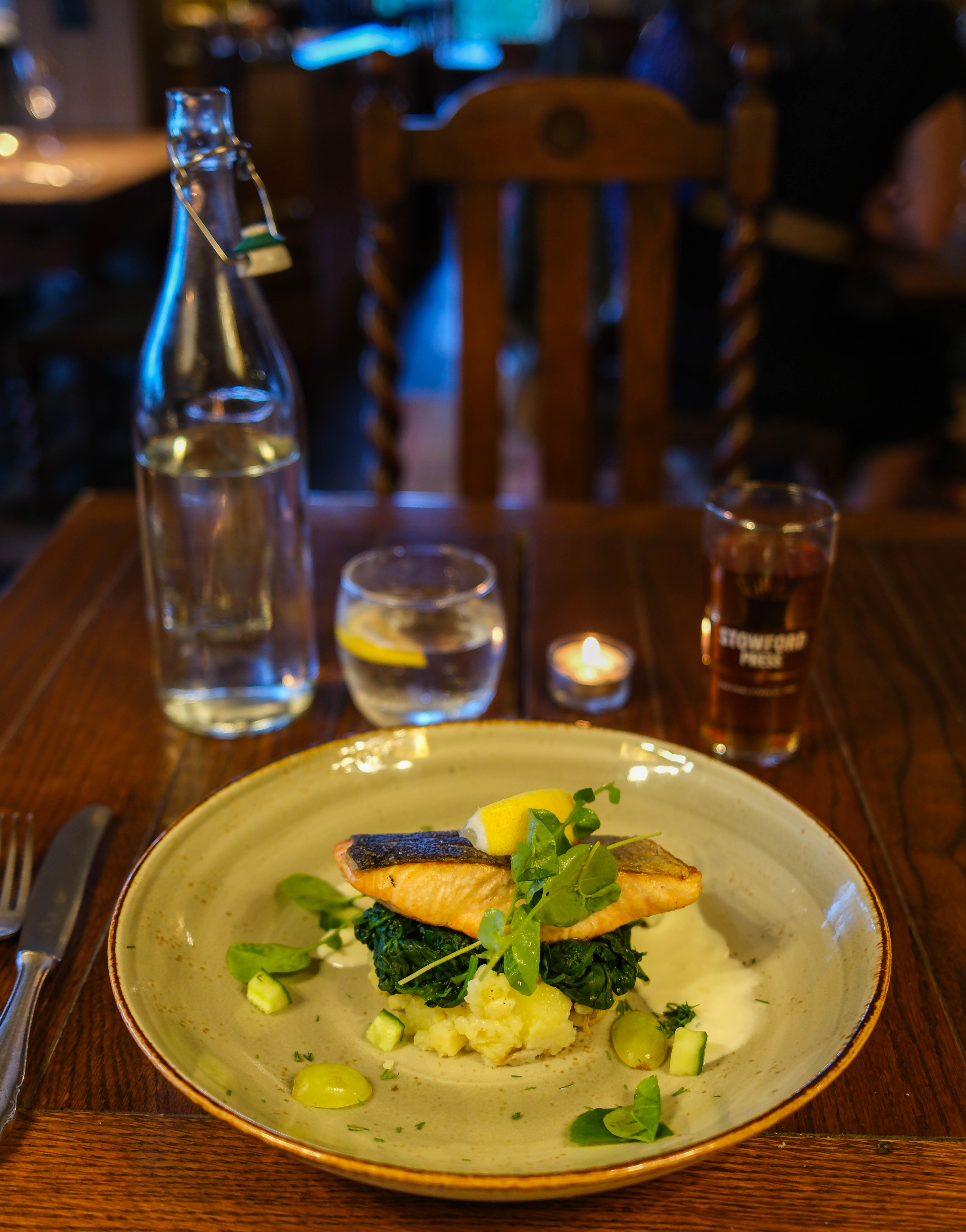
And it is all excellent! The soup is dense and flavorful, the fish -- perfectly prepared. One fourth the price of London, twice the tastiness. I'm not surprised.
It's very very late when I finally turn out the light. The Internet here is breathtakingly slow and I posted a record 43 photos today, each one taking seemingly hours to load. But I'm deeply content. Vita and Harold's garden, struggling between privacy and openness to the public in their lifetime, reminds me of my own ambivalence with this. As you know the farmette gardens are exceptionally private. Almost no one sees them in person. At the same time, I post endless photos of them here, on Ocean. Vita wrote about her gardening experiences in great detail (and wit and wisdom) for the Observer, without specifically mentioning what she was describing -- Sissinghurst. When she and Harold experimented with opening the estate to visitors (for a year or two they did this, for a couple of hours a week, charging a small entrance fee which you dropped in a bucket), Harold was appalled at the occasional presence of strangers. Vita, on the other hand, accepted it as a price to pay for having others see her work.
Tomorrow, I'll return to the gardens. Tonight, I have to log in some sleep!


