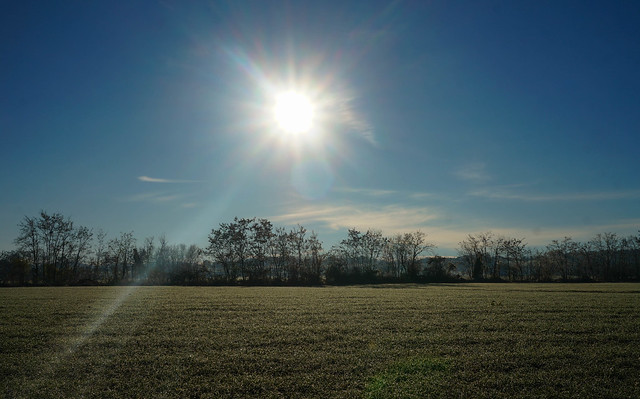
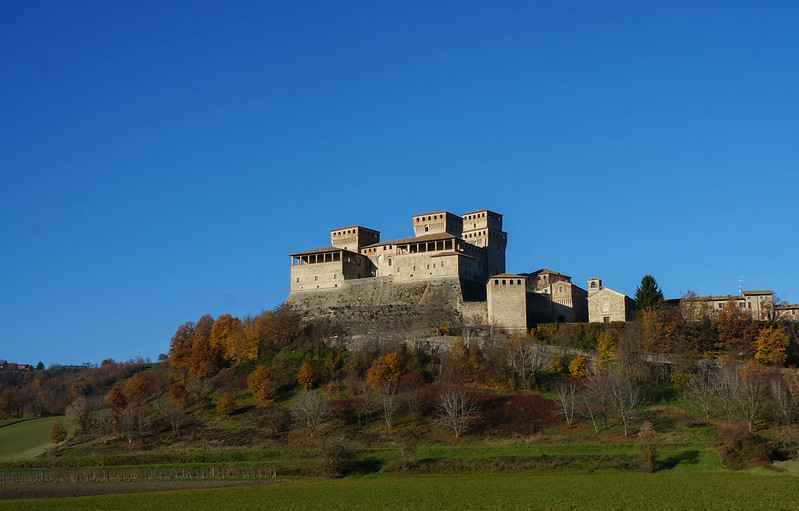
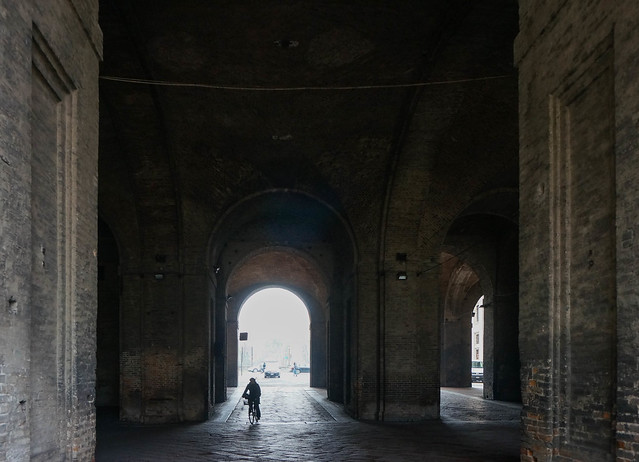
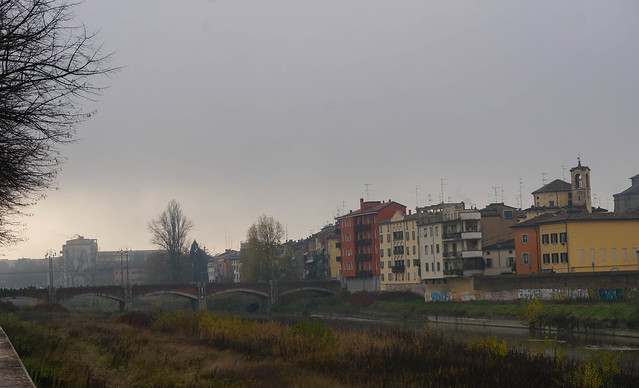
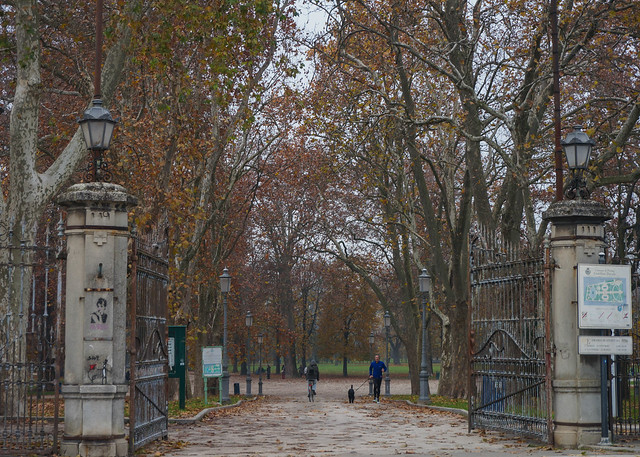
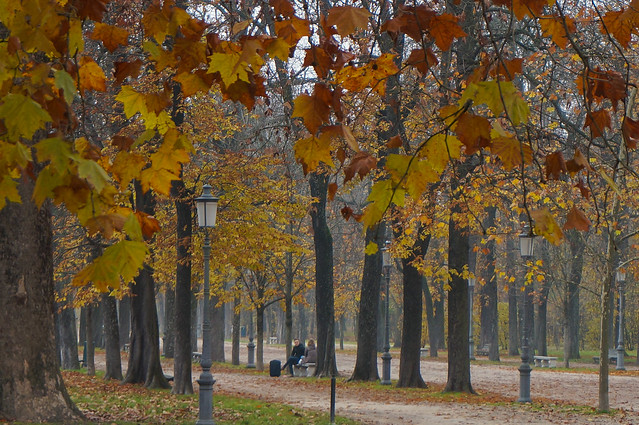
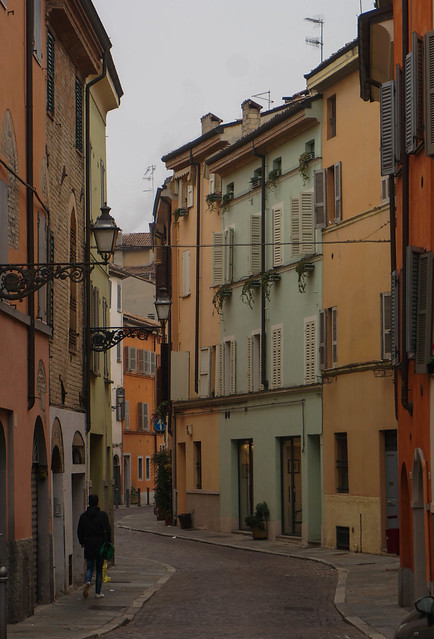
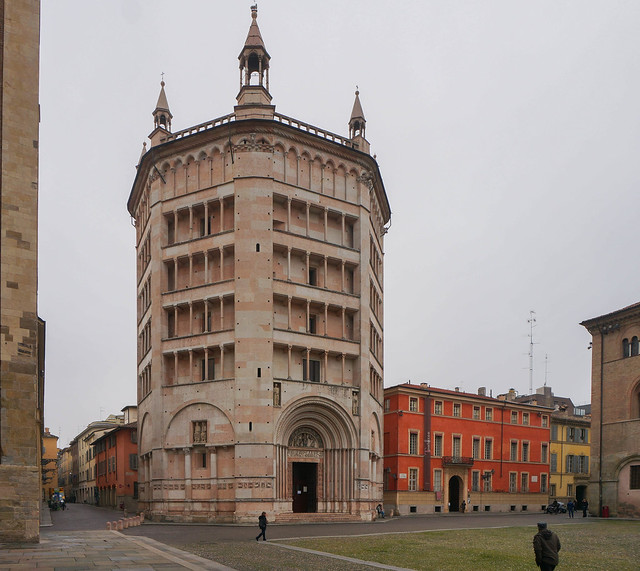
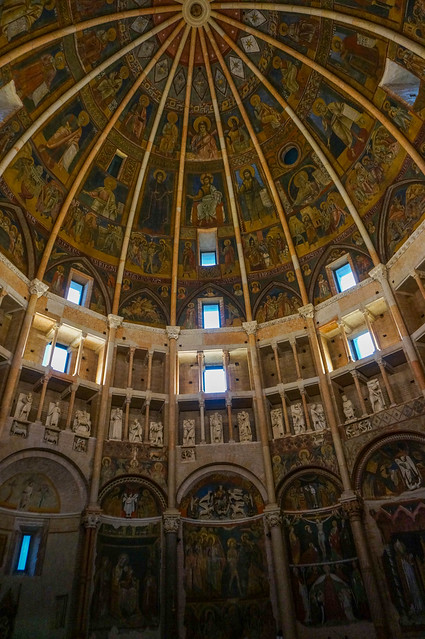
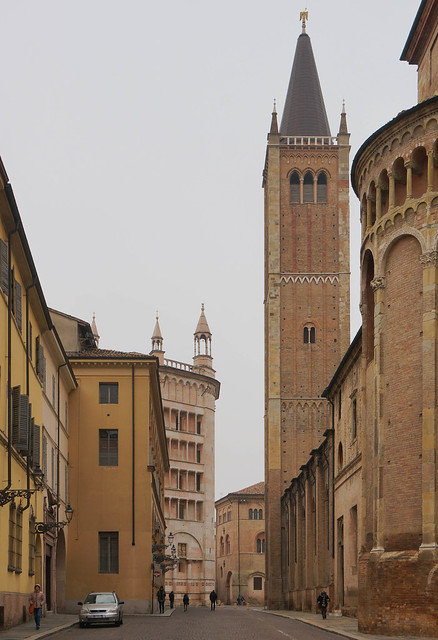
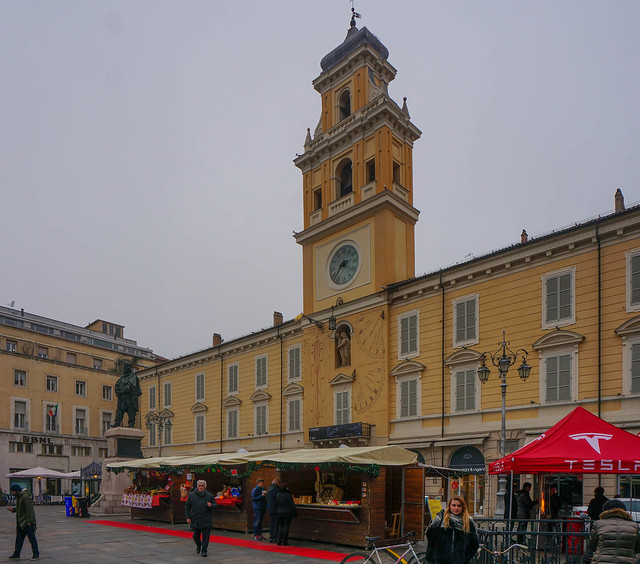
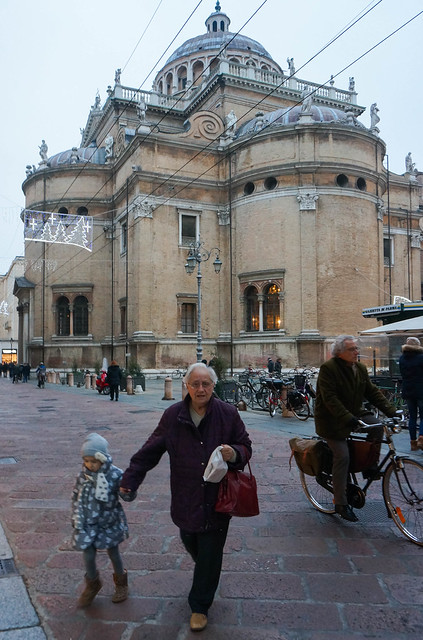
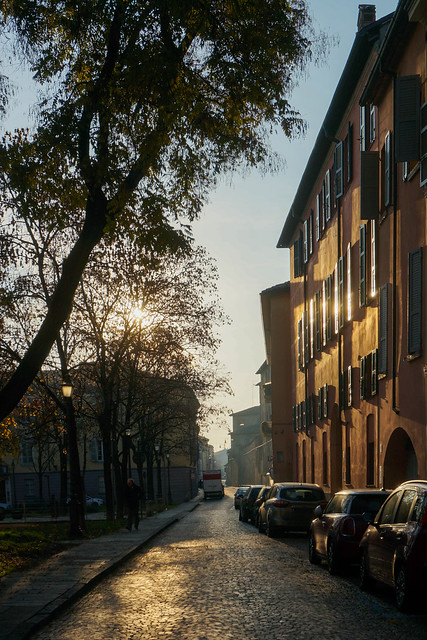
Well, I will surely always remember this day in Parma. First of all, it tried valiantly to fight off the fog each day and for a period of a few hours, it succeeded, before giving in again to the winter clouds.
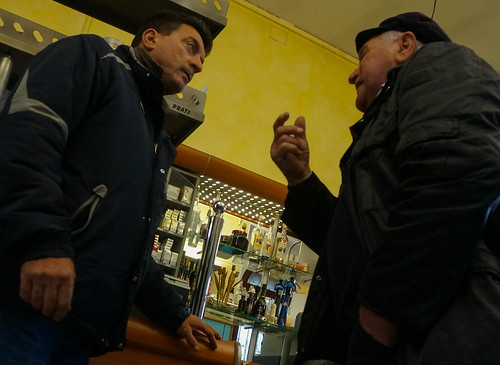
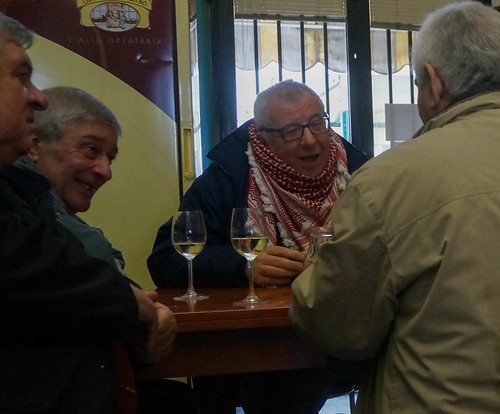
Secondly and more importantly, I will remember the time I spent with the Parmigiani.
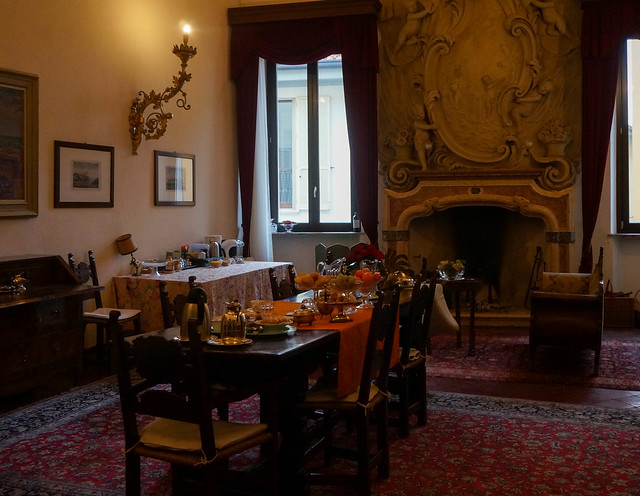
And so again I am up early, wondering if my eyes will learn to shake that pinkness associated with too little sleep (I blame Ocean). I eat the same delicious breakfast, artfully presented by Patrizia.
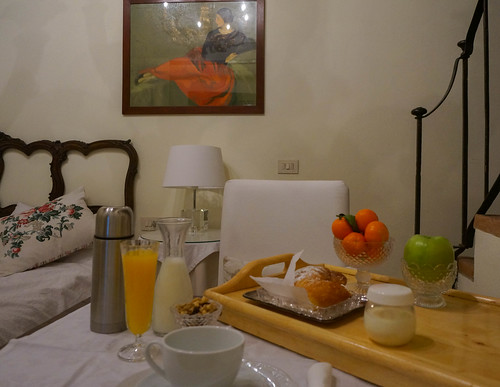
And then, at 9, Patrizia and I set out.
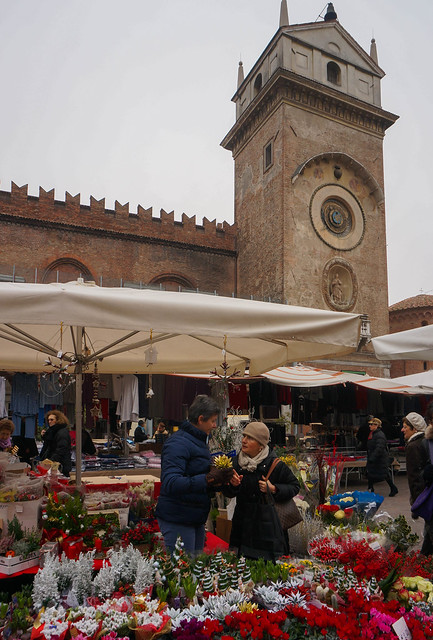
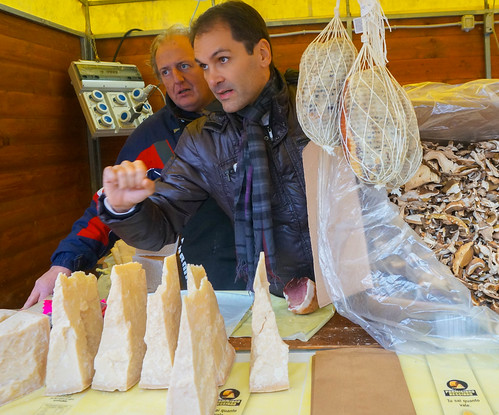
She had invited me to go to the market with her and I was happy to tag along. It's twice a week, she says. And it's very interesting. Full of Parma flavor. Are you thinking maybe of taking some good dried mushrooms back with you? I'll show you where to get them.
And lo, the sun comes out again.
We turn to the blocks where the market stalls spread out. I tend to bypass the European stalls with clothes and goods of a material nature, concentrating on the foods instead, but Patrizia isn't so dismissive.
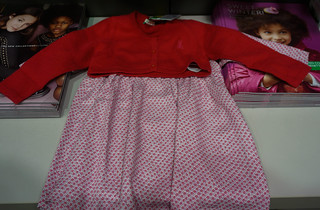
Take a look here: crazy, but beautiful, no? She points to a lovely little undergarment, then to a hat, a shawl...
They're good brands, discarded by the big stores. Look!
I tell her that in my retirement, I haven't the need for special clothing.
She looks at me blankly. We're speaking in English and I think she must not have understood my words. I repeat it, using other formulations.
She remains truly puzzled. Here, we're taught from early on to always look after our outside and our inside. To dress well, look well, eat well, talk well. It's important for the whole person, no?
I have no argument, except to say that perhaps in the States we've neglected lately the "look well dress well" part.
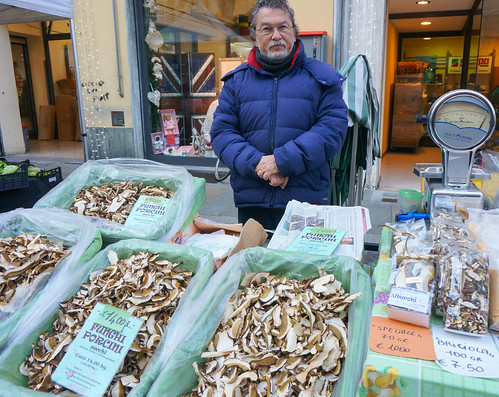
I buy my dried mushrooms. She banters with the seller. It's as if they were friends. Maybe they are friends. She knows this market inside out.
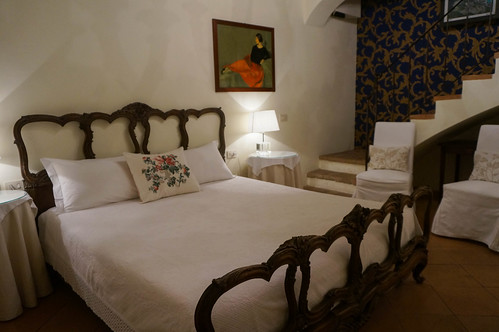
And then she walks me to another set of blocks, where she has arranged for me to spend many hours with her friend's wife, Ricarda (her friend restores old painting in Parma and, too, he is a painter whose paintings adorn some of the walls at the b&b).
Listen, Ricarda is older and she speaks no English, but I think your Italian is good. You will manage. I know you will.
Patrizia exudes confidence in me. About herself -- she is self deprecating, even though I'm pretty darn sure that she really likes who she is in life. My parents, they are much younger than me... she'll say vehemently. You cannot walk many paces with her without cracking a smile.
What Ricarda knows is perhaps not English, but she knows and loves Italian cooking. She and I will be cooking together this morning. But no meat dishes please -- I tell my co-conspirator, Patrizia. I can't bring back recipes for veal, it just wont work at the farmhouse!
I enter Ricarda's home on the top floor of an ancient building. The walls are filled with art...
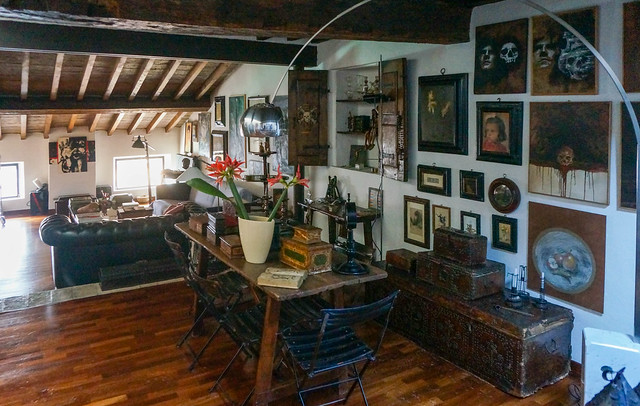
... and I mean filled with art.
Ricarda herself is lovely and genteel, dressed as if she were to cook, but also to host a grand feast.
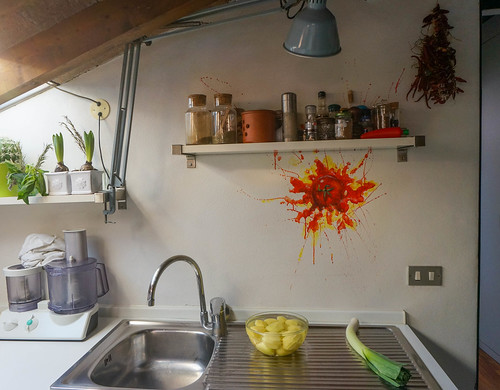
We enter her spacious kitchen which, due to the sloping roof, has the feel of a secret attic.
I got ingredients for three pasta dishes, she tells me. Tortelli with potatoes, torelli with chard, and lasagna Genovese -- with pesto and potatoes. No meat! -- she grins a full-faced grin.
This is, to me, a wonderful set of dishes. Not only might I make them at home, but, too, it is what people eat here. It is what she knows. It's what a person from Parma would have been raised on.
I ask her who taught her to cook.
No one! She says. But when pressed, she admits to using recipes passed down from her own nonna (grandma). Of course. It starts somewhere.
We make the potato stuffing (which, predictably has much more than just "potato" in it).
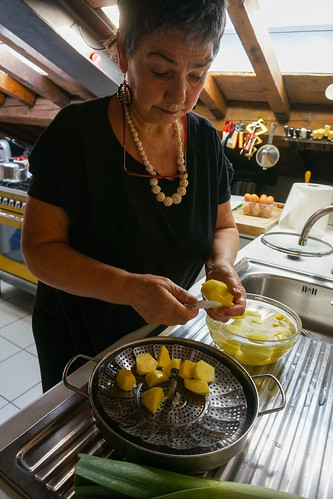
(I'd never considered cooking potatoes in a steamer before)
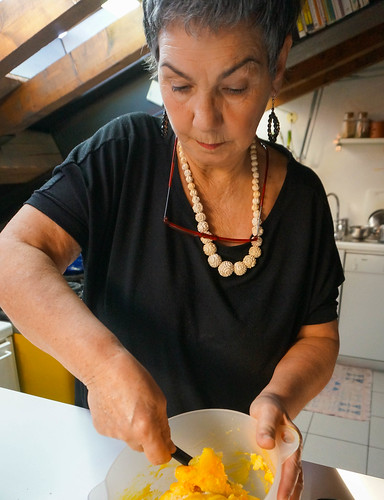
We make the ricotta and chard stuffing. We make the pesto and the bechamel sauce for the lasagna.
And finally, we make the pasta -- eggy and soft -- by hand.
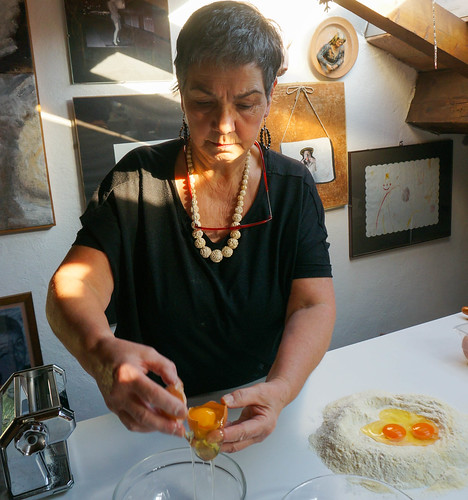
such orange yolks!
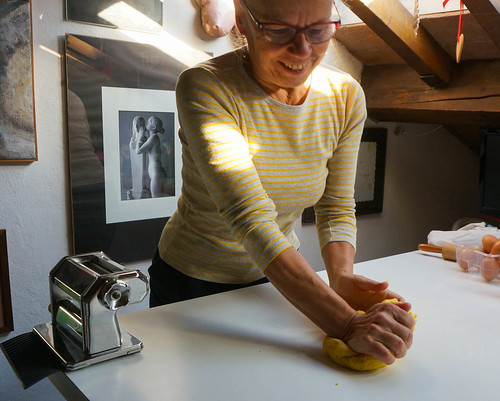
Dig in those palms, she tells me, watching my too gentle a touch.
When I go to rinse my hands, she reaches into her drawer to get me a fresh towel.
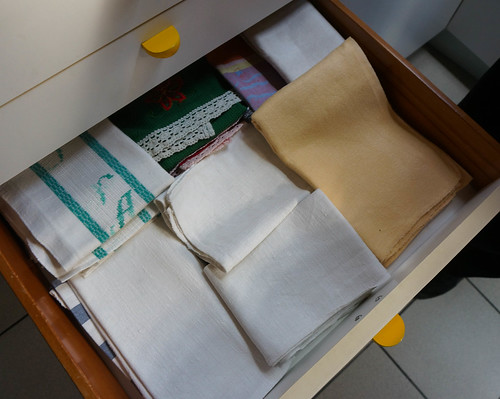
I cannot believe it! You iron all your dish towels? I ask, rather bluntly. She laughs. A complete waste of time, isn't it? Yet somehow I feel she doesn't really think it's a waste of time.
We're ready to throw it all together. Well, she's ready. I find that making the pockets out of the thin bands of pasta, so that no air bubbles remain inside is tricky. Push out the air first! -- she says again and again. By the sixth time, I get it right and after that we work in tandem, producing very many very wonderful looking tortelli.

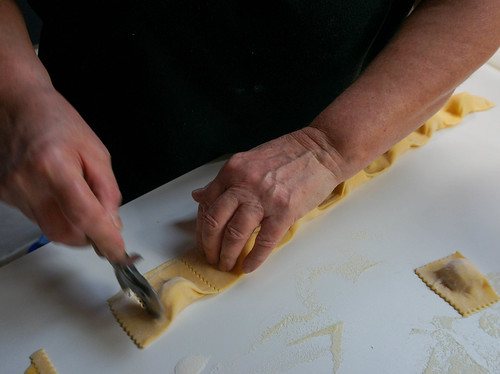
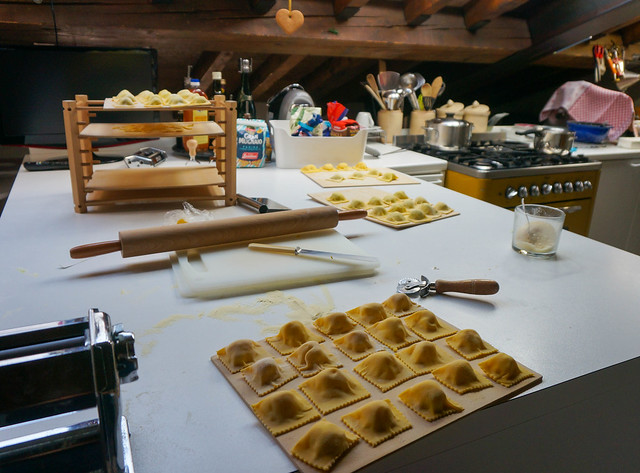
... to the background of a CD. She hums bits of a melody and I say -- you're a romantic! She answers -- it's not just any music, it's Francesco de Gregori. I tell her I taught my daughters to love Italian pop when they were very young. She reaches for the two-CD set that had been playing. I want you to have this. I offer no protest.
Ricarda wants to send all the food we make together home with me but of course, this wont do. We decide to gift it to Patrizia.
After sampling the tortelli ourselves.
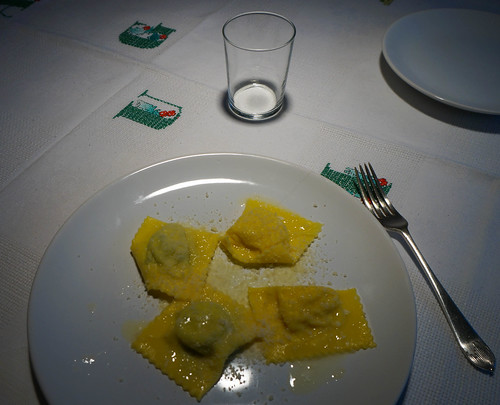
Delicious!!
She walks me back to the b&b and we side-step a little across the river... (could it be fog again?)
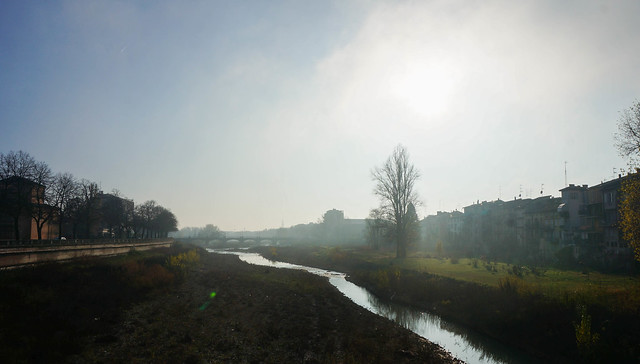
... because she wants to show me an out of the way little shop with all sorts of Italian cooking tools.
You need a tortelli wheel, she says. You don't have one?
I don't have one. They're cheap and I know I can get one in the States, but somehow it seems right to be looking for one with Ricarda. And she finds it, right there at the market, as the cooking tools guy is packing to go.
She is taking it to America -- Ricarda tells him.
Well now, maybe you want the professional one for 14 Euro?
This, this is perfect -- she picks up the cheap one for 3E. My kind of shopping.
At the b&b, Patrizia is thrilled with the food. You know I hate to cook, she reminds me.
Ricarda claims I managed well with her rapid Italian. Indeed -- in addition to the cooking tips, the recipes, her thoughts on food, I learned about her family and of course she knows all about my two daughters with their very Italian sounding names and, too, about Snowdrop. I show off a photo of the littlest one on my iPhone. Snowdrop is grinning impishly at my camera.
She is so smart looking! Patrizia tells me. I beam.
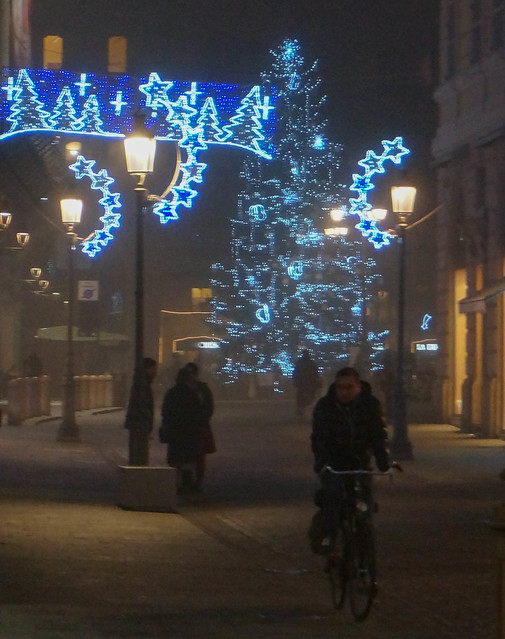
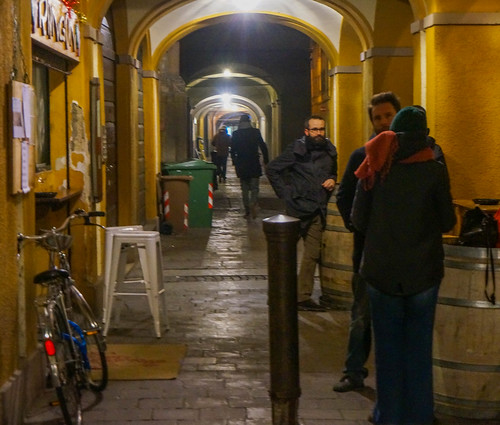
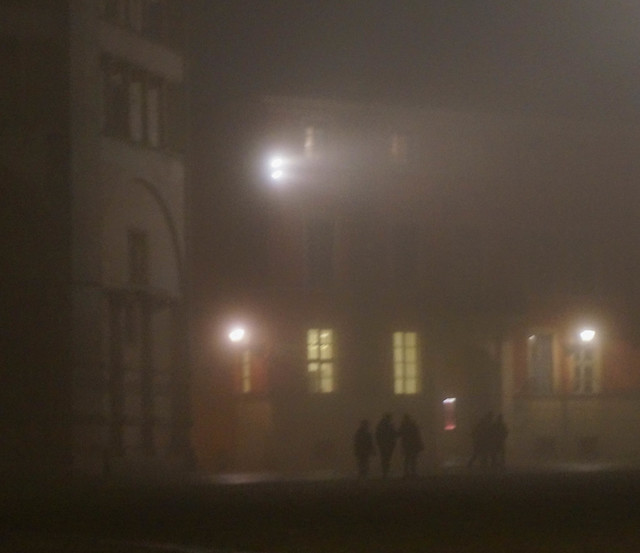
The thick fog rolls in on this, my last evening in Italy. I go for my last longer walk. No museums today. No visits to the ten sights I have on my "must see" list from Patrizia. I have to put off the visual beauty of Parma. I am, tonight, focused on her people.
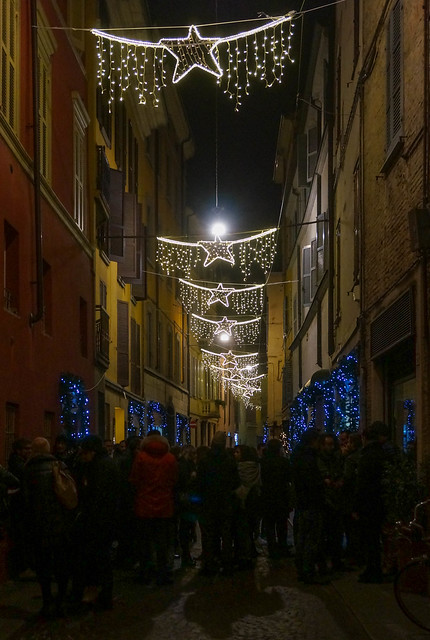
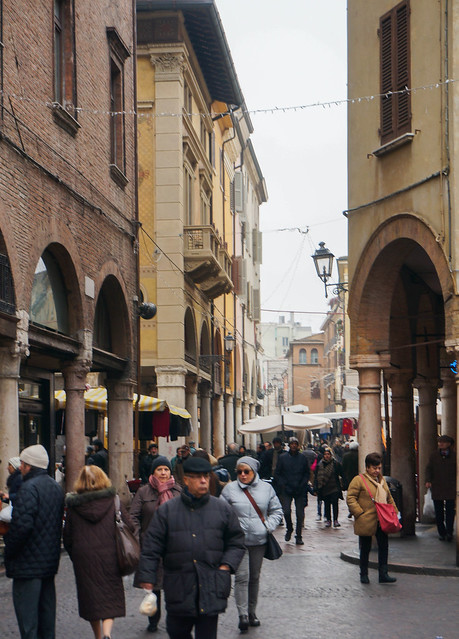
And here's a surprise, though maybe it should not be a surprise: the streets are packed! Not hundreds out there, but thousands -- weaving in and out of the dense fog.
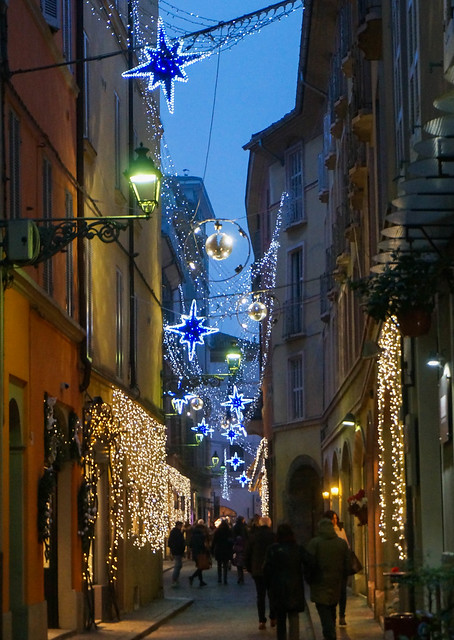
The joy of a stroll together on the weekend before a holiday -- no, this is not something you can stay away from.
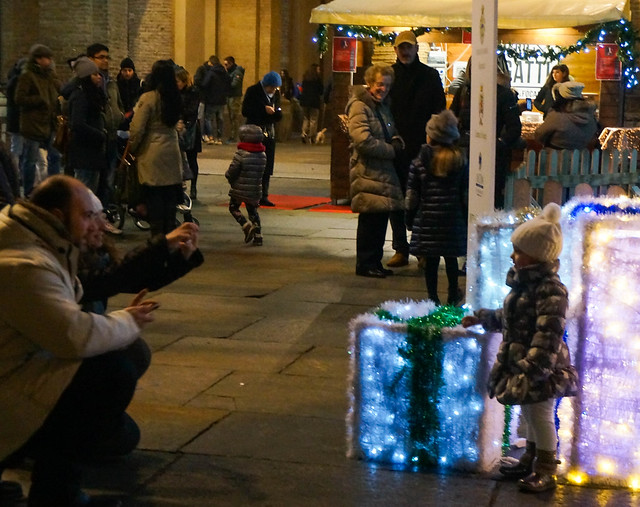
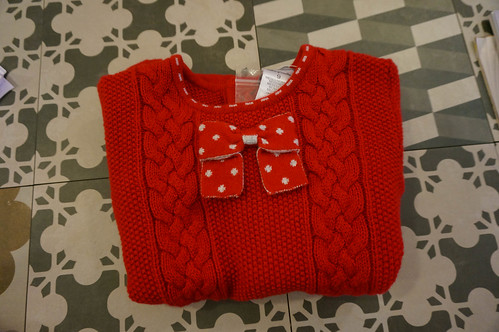
(A kids clothing shop? Let me look inside...)
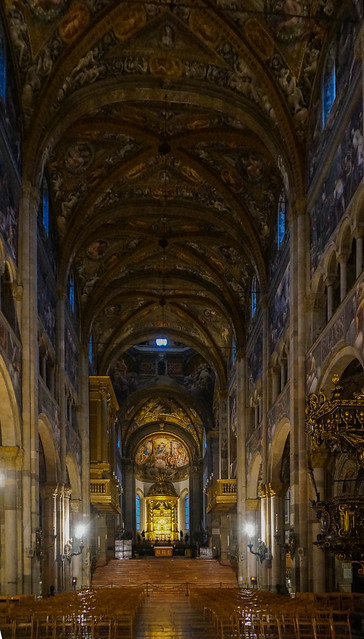
And the Duomo is suddenly experiencing a busy spurt as well. Families come, they go in they go out. Why? Is there a service? I open the doors.

No service -- they all come to take a peek at the Nativity scene. It's not much, by the standards of the really flashy and elaborate Nativity scenes, but they come nonetheless and they look, and the kids, being Italian, run around the vast spaces of the church and then they leave.
At home again (how weirdly comfortable it is to call it that), I sort through notes and photos. Patrizia comes down and we talk about websites, Ed, friends. Will you come back -- she asks. It's a question with a very easy answer.
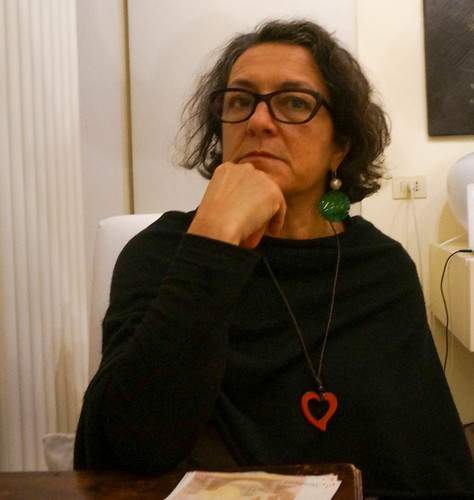
I eat dinner at another Patrizia favorite -- the Angiel d'Or. She worries that I wouldn't like it -- it's a little proper, she tells me.
I look at the prices. Not bad at all!
It's fine. I have a skirt I can wear. I'll look proper.
In fact, it's not at all staid. Tables are filled with families -- some with misbehaved children, others with perfectly behaved children, couples, young groups of friends -- this place has it all.
And the food is incredible.
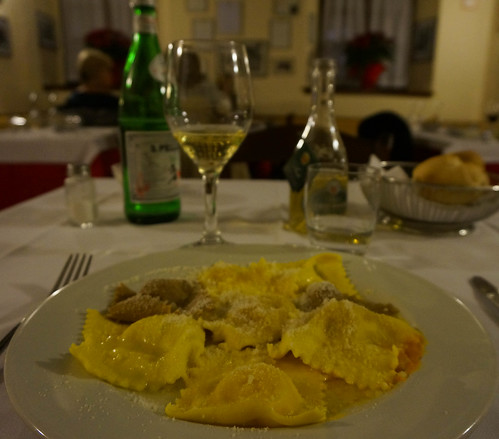
I overeat. I mean, it's my last night for the Prosciutto di Parma and though I asked for a half portion, I got charged for a half but given a full. Then the tortelli con zucca (pumpkin). But someone messes up here and they bring the tortelli con something else, definitely with a meat component. I decide not to protest, because it's plenty good, but the proprietor notices and comes over and insists on bringing a few of the pumpkin pasta tortelli. Of course I eat those as well.
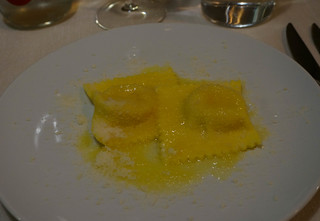
And then there's the house specialty which I have yet to figure out, even as I ate the whole thing. (It's a veal roll and I am guessing, based on taste and all the other rolls they favor in this part of the world, that there was plenty of bread, butter and cheese in the stuffing.)
So it was a superb meal. I'll have to admit -- the best of the best from my trip here.
And then I rush home -- a short walk down heavily fogged over streets...
... and I call Ed, expecting and in fact hearing the inevitable: Isie boy has passed on to another cat life. We knew it was coming. He truly was the oldest cat I have ever known: all rickety and bony and with hallowed eyes. I'd not been photographing him because I am sure that he would wish you would remember him from how he was when life seemed infinitely warm and never ending, out there on the porch with us (and especially his beloved Ed) at summer time.
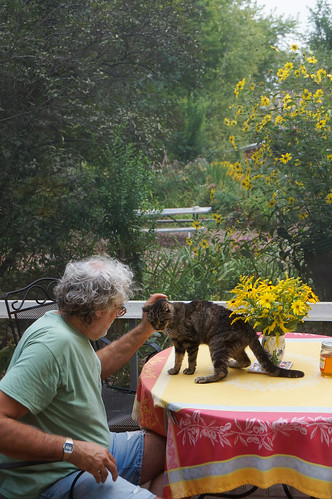
It's the only time that I am so very glad that Ed hadn't traveled with me to Europe. He could be there in the final hours with sweet sweet Isie boy.
Tomorrow I leave for Paris.
Secondly and more importantly, I will remember the time I spent with the Parmigiani.
And so again I am up early, wondering if my eyes will learn to shake that pinkness associated with too little sleep (I blame Ocean). I eat the same delicious breakfast, artfully presented by Patrizia.
And then, at 9, Patrizia and I set out.
She had invited me to go to the market with her and I was happy to tag along. It's twice a week, she says. And it's very interesting. Full of Parma flavor. Are you thinking maybe of taking some good dried mushrooms back with you? I'll show you where to get them.
And lo, the sun comes out again.
We turn to the blocks where the market stalls spread out. I tend to bypass the European stalls with clothes and goods of a material nature, concentrating on the foods instead, but Patrizia isn't so dismissive.
Take a look here: crazy, but beautiful, no? She points to a lovely little undergarment, then to a hat, a shawl...
They're good brands, discarded by the big stores. Look!
I tell her that in my retirement, I haven't the need for special clothing.
She looks at me blankly. We're speaking in English and I think she must not have understood my words. I repeat it, using other formulations.
She remains truly puzzled. Here, we're taught from early on to always look after our outside and our inside. To dress well, look well, eat well, talk well. It's important for the whole person, no?
I have no argument, except to say that perhaps in the States we've neglected lately the "look well dress well" part.
I buy my dried mushrooms. She banters with the seller. It's as if they were friends. Maybe they are friends. She knows this market inside out.
And then she walks me to another set of blocks, where she has arranged for me to spend many hours with her friend's wife, Ricarda (her friend restores old painting in Parma and, too, he is a painter whose paintings adorn some of the walls at the b&b).
Listen, Ricarda is older and she speaks no English, but I think your Italian is good. You will manage. I know you will.
Patrizia exudes confidence in me. About herself -- she is self deprecating, even though I'm pretty darn sure that she really likes who she is in life. My parents, they are much younger than me... she'll say vehemently. You cannot walk many paces with her without cracking a smile.
What Ricarda knows is perhaps not English, but she knows and loves Italian cooking. She and I will be cooking together this morning. But no meat dishes please -- I tell my co-conspirator, Patrizia. I can't bring back recipes for veal, it just wont work at the farmhouse!
I enter Ricarda's home on the top floor of an ancient building. The walls are filled with art...
... and I mean filled with art.
Ricarda herself is lovely and genteel, dressed as if she were to cook, but also to host a grand feast.
We enter her spacious kitchen which, due to the sloping roof, has the feel of a secret attic.
I got ingredients for three pasta dishes, she tells me. Tortelli with potatoes, torelli with chard, and lasagna Genovese -- with pesto and potatoes. No meat! -- she grins a full-faced grin.
This is, to me, a wonderful set of dishes. Not only might I make them at home, but, too, it is what people eat here. It is what she knows. It's what a person from Parma would have been raised on.
I ask her who taught her to cook.
No one! She says. But when pressed, she admits to using recipes passed down from her own nonna (grandma). Of course. It starts somewhere.
We make the potato stuffing (which, predictably has much more than just "potato" in it).
(I'd never considered cooking potatoes in a steamer before)
We make the ricotta and chard stuffing. We make the pesto and the bechamel sauce for the lasagna.
And finally, we make the pasta -- eggy and soft -- by hand.
such orange yolks!
Dig in those palms, she tells me, watching my too gentle a touch.
When I go to rinse my hands, she reaches into her drawer to get me a fresh towel.
I cannot believe it! You iron all your dish towels? I ask, rather bluntly. She laughs. A complete waste of time, isn't it? Yet somehow I feel she doesn't really think it's a waste of time.
We're ready to throw it all together. Well, she's ready. I find that making the pockets out of the thin bands of pasta, so that no air bubbles remain inside is tricky. Push out the air first! -- she says again and again. By the sixth time, I get it right and after that we work in tandem, producing very many very wonderful looking tortelli.
... to the background of a CD. She hums bits of a melody and I say -- you're a romantic! She answers -- it's not just any music, it's Francesco de Gregori. I tell her I taught my daughters to love Italian pop when they were very young. She reaches for the two-CD set that had been playing. I want you to have this. I offer no protest.
Ricarda wants to send all the food we make together home with me but of course, this wont do. We decide to gift it to Patrizia.
After sampling the tortelli ourselves.
Delicious!!
She walks me back to the b&b and we side-step a little across the river... (could it be fog again?)
... because she wants to show me an out of the way little shop with all sorts of Italian cooking tools.
You need a tortelli wheel, she says. You don't have one?
I don't have one. They're cheap and I know I can get one in the States, but somehow it seems right to be looking for one with Ricarda. And she finds it, right there at the market, as the cooking tools guy is packing to go.
She is taking it to America -- Ricarda tells him.
Well now, maybe you want the professional one for 14 Euro?
This, this is perfect -- she picks up the cheap one for 3E. My kind of shopping.
At the b&b, Patrizia is thrilled with the food. You know I hate to cook, she reminds me.
Ricarda claims I managed well with her rapid Italian. Indeed -- in addition to the cooking tips, the recipes, her thoughts on food, I learned about her family and of course she knows all about my two daughters with their very Italian sounding names and, too, about Snowdrop. I show off a photo of the littlest one on my iPhone. Snowdrop is grinning impishly at my camera.
She is so smart looking! Patrizia tells me. I beam.
The thick fog rolls in on this, my last evening in Italy. I go for my last longer walk. No museums today. No visits to the ten sights I have on my "must see" list from Patrizia. I have to put off the visual beauty of Parma. I am, tonight, focused on her people.
And here's a surprise, though maybe it should not be a surprise: the streets are packed! Not hundreds out there, but thousands -- weaving in and out of the dense fog.
The joy of a stroll together on the weekend before a holiday -- no, this is not something you can stay away from.
(A kids clothing shop? Let me look inside...)
And the Duomo is suddenly experiencing a busy spurt as well. Families come, they go in they go out. Why? Is there a service? I open the doors.
No service -- they all come to take a peek at the Nativity scene. It's not much, by the standards of the really flashy and elaborate Nativity scenes, but they come nonetheless and they look, and the kids, being Italian, run around the vast spaces of the church and then they leave.
At home again (how weirdly comfortable it is to call it that), I sort through notes and photos. Patrizia comes down and we talk about websites, Ed, friends. Will you come back -- she asks. It's a question with a very easy answer.
I eat dinner at another Patrizia favorite -- the Angiel d'Or. She worries that I wouldn't like it -- it's a little proper, she tells me.
I look at the prices. Not bad at all!
It's fine. I have a skirt I can wear. I'll look proper.
In fact, it's not at all staid. Tables are filled with families -- some with misbehaved children, others with perfectly behaved children, couples, young groups of friends -- this place has it all.
And the food is incredible.
I overeat. I mean, it's my last night for the Prosciutto di Parma and though I asked for a half portion, I got charged for a half but given a full. Then the tortelli con zucca (pumpkin). But someone messes up here and they bring the tortelli con something else, definitely with a meat component. I decide not to protest, because it's plenty good, but the proprietor notices and comes over and insists on bringing a few of the pumpkin pasta tortelli. Of course I eat those as well.
And then there's the house specialty which I have yet to figure out, even as I ate the whole thing. (It's a veal roll and I am guessing, based on taste and all the other rolls they favor in this part of the world, that there was plenty of bread, butter and cheese in the stuffing.)
So it was a superb meal. I'll have to admit -- the best of the best from my trip here.
And then I rush home -- a short walk down heavily fogged over streets...
... and I call Ed, expecting and in fact hearing the inevitable: Isie boy has passed on to another cat life. We knew it was coming. He truly was the oldest cat I have ever known: all rickety and bony and with hallowed eyes. I'd not been photographing him because I am sure that he would wish you would remember him from how he was when life seemed infinitely warm and never ending, out there on the porch with us (and especially his beloved Ed) at summer time.
It's the only time that I am so very glad that Ed hadn't traveled with me to Europe. He could be there in the final hours with sweet sweet Isie boy.
Tomorrow I leave for Paris.